
TL;DR
- Best overall for dedicated production inference: Simplismart, because one control plane runs dedicated GPUs in Simplismart's cloud, in your AWS, GCP or Azure account, or on-prem, with the serving stack tuned to each workload.
- Best managed dedicated platform for compliance-sensitive teams: Baseten, because it pairs dedicated deployments with SOC 2 Type II audits, HIPAA-eligible setups with BAAs, and self-hosted or hybrid options for extra isolation.
- Best for open-model variety plus training capacity: Together AI, because serverless, batch, dedicated endpoints and GPU clusters sit in one account.
- Best for serverless inference: Fireworks AI, because its per-token APIs serve the latest open models from 30+ regions, with on-demand and reserved deployments when you need dedicated capacity.
- Best for image and video generation: fal, because 1,000+ media models sit behind one API, priced per output.
Getting a model to work is rarely the hard part anymore. Keeping it fast, available, and affordable once real traffic arrives is where most teams struggle: GPU bills climb, latency spikes during peak hours, and compliance teams start asking where prompts and data actually go. AI inference platforms solve that by deploying, scaling, and optimizing models in production so your engineers don’t have to build that layer themselves.
The 10 platforms below take very different approaches. Some sell per-token access to hosted models, some give you dedicated GPUs, and a few run inside your own cloud account or data center. This guide compares them on deployment options, pricing, workload fit, and published customer results.
What is an AI Inference Platform?
An AI inference platform sits between GPUs and your application. It takes a model (open-source, fine-tuned, or your own weights), deploys it, exposes it as an API, batch job, or streaming endpoint, autoscales it, and monitors it. An inference engine such as vLLM runs the model efficiently; a GPU cloud rents you the hardware; the platform wraps both so the model can carry production traffic.
The choice now carries real weight: Deloitte predicts inference will account for roughly two-thirds of all AI compute in 2026. At the same time, per-token prices keep falling. Stanford’s 2025 AI Index found that GPT-3.5-level inference dropped from $20 to $0.07 per million tokens between November 2022 and October 2024. At those prices, most of the bill comes from volume, idle GPUs, and utilization, which is exactly what an inference platform is meant to manage.
Recommended read: What Is an AI Inference Platform? A Complete Guide for 2026
Top 10 AI Inference Platforms Compared
The table compares each platform on where it runs, what it does best, how it charges, and where it falls short.
How We Evaluated These Platforms
We reviewed more than 20 inference vendors that appear in buyer guides, practitioner discussions, and our own competitive research. We kept the 10 that a team could realistically use to serve production models. We left out products that solve a narrower problem: raw GPU capacity providers (such as RunPod and Vast.ai), speech-only APIs (such as AssemblyAI and Deepgram), and model routers (such as OpenRouter).
Each platform was assessed on the same six criteria:
We did not run one standardized benchmark across all 10 platforms, because latency and cost depend heavily on the model, GPU, and traffic pattern. The two-week evaluation plan later in this guide shows how to run that test on your own workload.
The Top 10 AI Inference Platforms in 2026: A Detailed Breakdown
1. Simplismart
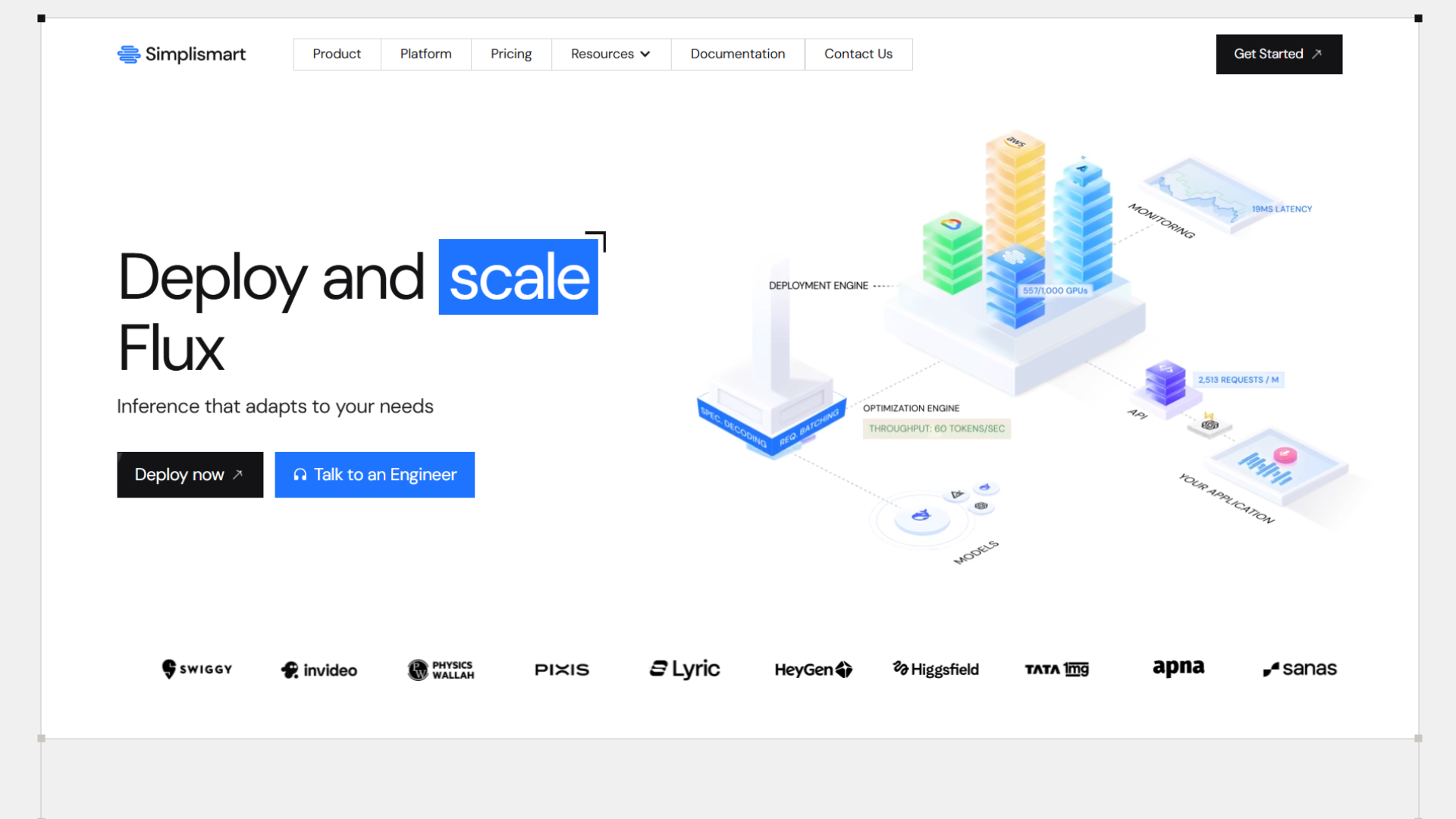
Simplismart is an AI inference platform built around dedicated deployments: your open-source, fine-tuned or custom model runs on GPUs reserved for you, with the serving stack tuned to the workload. It starts from the idea that one inference setup cannot fit every workload. A voice agent needs a fast first response, a document pipeline needs throughput, and a content-generation app needs a low cost per output, so Simplismart optimizes each deployment for its own target.
The same dedicated deployment can run wherever the workload has to live. On Simplismart's cloud, a dedicated endpoint gives you isolated GPUs from NVIDIA T4 to B200. In your own AWS, GCP or Azure account, Simplismart provisions and manages the cluster for you, typically in about 30 minutes according to its BYOC guide. It can also deploy onto a Kubernetes cluster you already run, including neoclouds and on-prem hardware, as well as Slurm clusters and air-gapped environments. Pay-as-you-go APIs for 150+ open models cover prototyping before you move to dedicated GPUs.
Key capabilities
- Dedicated endpoints: no compute shared with other users; deploy custom or fine-tuned weights, or containers from registries such as Docker Hub, NVIDIA NGC and Amazon ECR
- Serving modes: low-latency APIs, batch jobs or streaming endpoints, with sync, async and async real-time request handling
- Workload-specific optimization: quantization (FP8, INT4), custom CUDA kernels, speculative decoding and continuous batching, chosen per deployment
- Autoscaling on latency, concurrency and memory signals, with scale-to-zero when traffic stops
- One control plane across Simplismart's cloud, managed BYOC, imported Kubernetes, on-prem and air-gapped deployments
- Fine-tuning with LoRA, QLoRA, SFT, RFT, GRPO and DPO, plus a benchmarking suite for performance and quality
- Operations: SSH access to running containers, metrics export to Prometheus, Datadog and New Relic, alerts to Slack, PagerDuty and other channels, and a REST API, Python SDK and CLI
- Compliance: ISO 27001, SOC 2 Type 2, GDPR, HIPAA and CPRA badges shown on the site
Why teams choose it
- Lower dedicated GPU prices than several managed platforms: an H100 costs less per hour on Simplismart than on Baseten, Together AI's dedicated endpoints or Fireworks, and reserved capacity brings the rate down further.Predictable latency on GPUs that serve only your traffic, without building the scaling and optimization layer yourself.
- Data and models can stay in your own account or data center, and existing AWS, GCP or Azure commitments can pay for the GPUs.
- The same GPUs serve more requests at lower cost because the stack is tuned per model and workload.
- Deployments reach production fast: Invideo moved from proof of concept to production in 3 to 4 days instead of about 2 weeks, and Lyric went live in 2 days.
Pricing
- Dedicated GPUs from $1.20 (T4) to $5.20 (H200) per GPU-hour. T4 through H100 come in 1, 2, 4 or 8-GPU instances, while H200 and B200 come as 8-GPU instances, with B200 and reserved capacity priced on request. One H100 at $5.00 per hour costs about $3,650 for a month running 24/7 (730 hours), before scale-to-zero or reserved pricing.
- Model APIs from $0.06 per million tokens (Gemma 3 1B); Llama 3.1 8B at $0.13; Whisper v3 Turbo at $0.0018 per audio minute; Flux Dev at $0.03 per image.
- BYOC and on-prem pricing by consultation.
Best fit: engineering teams running production GenAI on dedicated GPUs, especially where models must stay in their own cloud or data center, cloud commitments need to be used, or workloads such as voice agents, transcription, document AI and image or video pipelines need tuning for latency, throughput or cost.
Not the right fit: teams that only need a closed frontier model such as GPT or Claude, since Simplismart serves open-source and custom models.
2. Baseten
Baseten is a managed inference platform for running open-source and custom models in production. Teams define a model with a configuration file, a Python model class or a custom Docker server, deploy it with the Baseten CLI, and get an autoscaling endpoint on dedicated GPUs with control over hardware, scaling and releases. Alongside Dedicated Inference, it offers Model APIs, Training with your own code or its Loops SDK, Sandboxes for agents, and Grid, a control layer for governing model access, monitoring usage and routing requests.
It is built for compliance-sensitive teams that want dedicated inference handled by a vendor rather than an internal platform team. Customers shown on its site include Abridge, Cursor, HubSpot, Notion, OpenEvidence, Ramp and Wayfair. Most run on Baseten Cloud; for customers that need more isolation, Baseten offers single-tenant dedicated clusters, self-hosted deployment in your own VPC and hybrid setups that spill over to Baseten Cloud.
Key capabilities
- Dedicated deployments with capacity across 30+ clouds and automatic failover when a GPU or cloud fails
- Runtimes tuned for embeddings and rerankers, voice and audio models, plus speculative decoding and fused kernels
- Model APIs with separate input, cached-input and output pricing
- Training, Sandboxes and Grid on the same platform
Strengths
- Strong reference base: OpenEvidence reports a 3x speed improvement after moving to Baseten Embeddings Inference
- SOC 2 Type II audited, with HIPAA-eligible configurations and Business Associate Agreements for qualifying customers
- Engineers on call 24/7 who work as an extension of your team
Limitations
- On-prem, air-gapped and Slurm deployments are not listed
- The H100 list rate is higher than several platforms in this list
Pricing: pay as you go with no contracts, or custom pricing, volume discounts and reserved compute for production scale. H100 is $0.10833 per minute (about $6.50 an hour, or roughly $4,745 for a month running 24/7) and A10G is $0.02012 per minute. gpt-oss-120B costs $0.10 per million input tokens and $0.50 per million output tokens.
Best fit: US product teams that want a widely used vendor for dedicated inference on Baseten's cloud.
Not the right fit: teams that need on-prem or air-gapped deployment.
3. Together AI
Together AI positions itself as an AI-native cloud that combines inference, model shaping and GPU infrastructure under one account. On the inference side, it offers serverless and batch APIs across a large open-model catalog, provisioned throughput for reserved capacity, and dedicated endpoints for both listed models and your own containers. On the compute side, it rents GPU clusters on demand or by reservation, and it adds fine-tuning, custom training and evaluations on top.
Its research team is behind FlashAttention, which shows up as fast support for newly released open models. It suits AI-native companies that want many models and training capacity from one vendor; customers named on its site include Cursor, Decagon and Vercept.
Key capabilities
- Serverless and batch inference across a large open-model catalog
- Dedicated endpoints and provisioned throughput for predictable capacity
- On-demand and reserved GPU clusters for training
- Supervised and preference fine-tuning, plus evaluations
Strengths
- Broad, quickly updated open-model catalog
- Inference and training capacity from one vendor
- Customer evidence: Together reports that Decagon reached about 6x lower cost per turn than gpt-5 mini
Limitations
- Runs only on Together's infrastructure; no BYOC, VPC or on-prem option is listed on its pricing page
Pricing: gpt-oss-120B at $0.15 per million input tokens and $0.60 per million output tokens. Dedicated H100 endpoints cost $5.49 per GPU-hour on demand (about $4,008 for a month running 24/7) and B200 $8.99; GPU clusters start at $3.99 per H100-hour on demand, or $3.69 reserved (pricing).
Best fit: teams that switch between many open models, run large batch jobs, or need training clusters alongside inference.
Not the right fit: workloads that must run inside your own cloud account or data center.
4. Fireworks AI
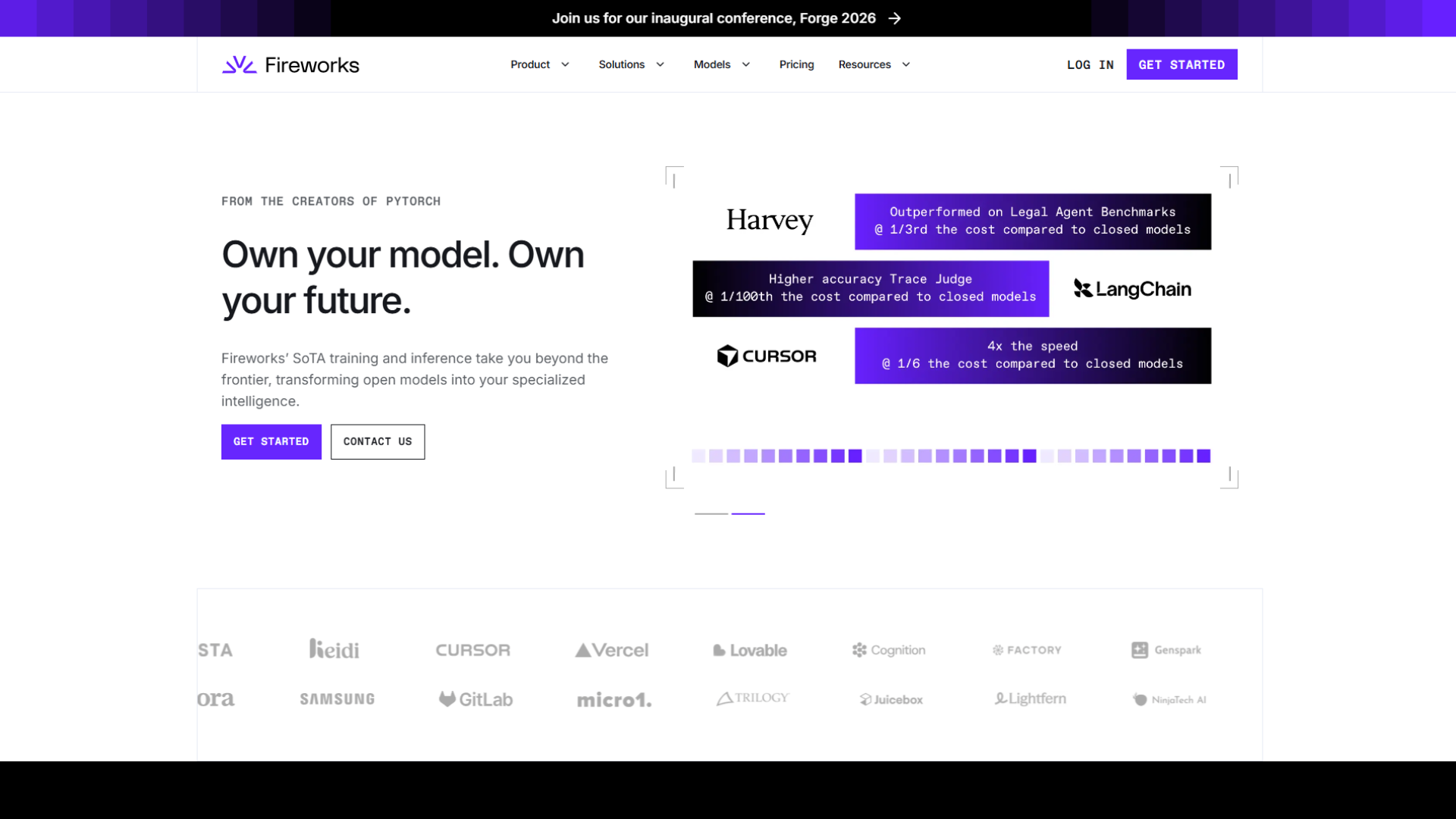
Fireworks AI positions itself as a specialized intelligence platform: run open models, route between them to cut cost, and train them on your own data. Inference comes as serverless per-token APIs, on-demand dedicated deployments and reserved capacity, served from 30+ regions with policy-aligned data residency and zero data retention by default. For Azure customers, Fireworks is a first-party provider in Microsoft Foundry.
Fireworks now also runs inside your own cloud. Its Sovereign offering, in private preview for enterprise customers on a contract, deploys the Fireworks engine in your environment with optional overflow to Fireworks-managed capacity. It is aimed at product teams that want a tuned open model to replace a closed one; Fireworks says 10,000+ companies use the platform, including Notion, Cursor, Vercel, DoorDash and Shopify.
Key capabilities
- Serverless, on-demand and reserved inference behind the same API
- Training for open models, from guided runs to custom reinforcement learning
- Model ensembling that routes each request to the model that fits cost and accuracy
- Bring-your-own-cloud deployment through Fireworks Sovereign
Strengths
- Post-training and serving in one place
- Customer evidence: Genspark's CTO says Fireworks helped the team "unlock better quality in just four weeks"
Limitations
- On-demand GPU rates are higher than several platforms in this list
- Bring-your-own-cloud is still a private preview tied to an enterprise contract
Pricing: serverless usage is billed per token. On-demand deployments list H100 and H200 at $8.00 an hour and B200 at $13.00 an hour, with no charge for start-up time; region-restricted deployments cost 1.5x. One H100 running 24/7 comes to about $5,840 a month.
Best fit: coding assistants, agents and search products that need a tuned open model at production scale.
Not the right fit: teams that need self-serve deployment inside their own VPC today.
5. Modal
Modal is a serverless cloud for AI workloads rather than an inference-only product. Developers describe functions, dependencies, and GPU requirements in Python; Modal builds the containers, provisions GPUs on demand from a capacity pool spanning 20+ clouds, routes work to available hardware and regions, and bills per second. The same runtime serves LLM, image, video, and audio models in real time or batch, and also runs training jobs, notebooks, and isolated sandboxes for coding agents and RL rollouts.
Because you write the serving code yourself (vLLM, SGLang or a custom server), Modal suits engineering teams that want elastic GPUs without managing Kubernetes but are happy to own the inference stack. Customers named on its site include Cognition, which uses it for RL infrastructure and production inference, DoorDash, and Ramp.
Key Capabilities
- Python SDK that maps code, dependencies, and GPU needs to containers
- Per-second autoscaling, including scale-to-zero
- HTTP endpoints, batch jobs, sandboxes, and training on the same runtime
Strengths
- Very fast path from Python code to a GPU endpoint
- Good fit for spiky and batch traffic thanks to per-second billing
- Customer evidence: TypeSafe AI says it served 1 trillion tokens within three days of launch on Modal
Limitations
- You choose, configure, and tune the serving engine yourself
- No deployment into your own cloud account; HIPAA, SSO, and audit logs are Enterprise-only
Pricing: Starter is $0 a month plus compute, with $30 of monthly credits; Team is $250 a month plus compute, with $100 of credits. H100 costs $0.001097 per second (about $3.95 an hour).
Best fit: small Python teams with bursty or batch workloads that are comfortable owning the serving stack.
Not the right fit: teams that want model-level optimization handled for them.
6. GroqCloud
Groq designs its own inference chip, the LPU (Language Processing Unit), and runs it in its own data centers rather than selling software for GPUs. Developers reach it through GroqCloud, a hosted API with free and pay-as-you-go developer tiers covering LLMs such as gpt-oss-120B, speech-to-text models such as Whisper Large V3 and text-to-speech models such as Orpheus. Larger customers can buy dedicated bare-metal capacity, an inference stack for production use and governance features, across 11 listed regions in North America, Europe, the Middle East and Australia.
Groq’s appeal is low per-user latency on the models it hosts, which matters most for chat, agents and voice. The company changed shape in December 2025, when it signed a non-exclusive licensing agreement with NVIDIA and its founder moved to NVIDIA; Groq said GroqCloud would continue operating independently.
Key Capabilities
- Hosted models such as gpt-oss-120B, Whisper Large V3 and Orpheus TTS
- Dedicated bare-metal capacity for larger customers
- Batch processing on the Developer tier
Strengths
- Custom hardware designed for low per-user latency on supported LLMs
- Simple per-token pricing for hosted models
Limitations
- You can only use models Groq hosts; custom weights and fine-tuning are not listed.
- No image or video generation, and no deployment in your own cloud
Pricing: gpt-oss-120B at $0.15 per million input tokens and $0.60 per million output tokens; Whisper Large V3 Turbo at $0.04 per hour of audio.
Best fit: chat, agent, and voice products where time to first token matters most, on a model Groq supports.
Not the right fit: teams running custom or fine-tuned models.
7. fal
fal is an inference platform built specifically for generative media. Its hosted catalog covers 1,000+ image, video, audio, and 3D models behind a single API, so a product can switch between image generators or video models without new integrations. Teams with their own models can deploy them on fal’s serverless GPUs, which scale from zero across globally distributed capacity, use private endpoints for fine-tuned or custom weights, or rent dedicated H100, H200, and B200 clusters for training.
fal is aimed at consumer and creative apps whose costs track media output rather than tokens, which is why most of its catalog is priced per image or per second of video. Enterprise customers get SOC 2 compliance, SSO, usage analytics, and 24/7 priority support.
Key capabilities
- Hosted image, video, audio, and 3D models through one API
- Serverless GPUs that scale from zero for custom models
- Private endpoints and dedicated GPU clusters
Strengths
- Very wide media model catalog with no setup
- Per-output pricing that maps directly to product usage
Limitations
- Not designed for LLM-heavy products
- Runs on Fal’s infrastructure only
Pricing: hosted models are priced per output, for example, $0.07 per second of video for Kling Video v2.5 Turbo Pro. H100 GPUs start at $4.50 an hour at list price, dropping to $2.49 on its lowest tier.
Best fit: consumer and creative apps that call many image and video models.
Not the right fit: LLM agents or workloads with strict data-residency needs.
8. Bento Inference Platform
BentoML started as an open-source framework that packages a model, its dependencies, and inference code into a versioned, portable artifact called a Bento. The managed Bento Inference Platform runs those packages as real-time APIs, asynchronous jobs, batch jobs, or multi-model pipelines, with autoscaling, scale-to-zero, CI/CD, and observability. Deployments can run on Bento’s own cloud or in your account through BYOC, with VPC and on-prem options on enterprise plans.
Its code-centric approach suits teams that already write Python serving logic and want the same package to run across clouds, including teams mixing traditional ML models (PyTorch, TensorFlow, scikit-learn) with LLMs. Modular acquired BentoML, and BentoML’s sign-up and pricing now run through Modular, so the platform is likely to converge with Modular’s own inference stack.
Key capabilities
- Portable Bento packages that run across clouds and on-prem
- Multi-framework serving for PyTorch, TensorFlow, and scikit-learn as well as LLMs
- Autoscaling and scale-to-zero on managed infrastructure or your own
Strengths
- Natural path for teams already using open-source BentoML
- Handles traditional ML and GenAI models on one platform
Limitations
- Product direction is changing as it merges into Modular’s stack
- Model-level optimization is largely left to your team
Pricing: pay-as-you-go compute billed per second, for example, a T4 at $0.00014 per second; enterprise plans by quote.
Best fit: teams with existing BentoML code or a mix of classic ML and GenAI models.
Not the right fit: teams that want the vendor to tune models for them.
9. Hyperscaler Services: SageMaker and Bedrock, Vertex AI, Azure AI Foundry
Each major cloud offers its own inference services, and they usually come in two forms. On AWS, Amazon SageMaker deploys models you bring to real-time, serverless, asynchronous, or batch endpoints on instance types you choose, while Amazon Bedrock gives per-token API access to foundation models from Amazon and other providers. Google Vertex AI offers online and batch prediction endpoints plus Model Garden, which includes Gemini and open models. Microsoft Azure AI Foundry combines serverless model APIs, including third-party providers such as Fireworks, with managed compute you size yourself.
Teams pick these services mainly because everything else already lives in that cloud: identity and access, networking, security reviews, procurement, and committed spend. They are general machine learning platforms first, so inference-specific tuning such as custom kernels, batching strategy, and autoscaling signals is largely left to you.
Strengths
- Reuse existing IAM, networking, procurement, and committed spend
- Broad catalogs that include each cloud’s own models
Limitations
- Less inference-specific optimization than specialized platforms
- GPU quotas can be hard to get in some regions, and there is no path to another cloud
Pricing: per instance-hour for managed endpoints and per token for model catalogs, varying by instance type and region.
Several platforms in this list, Simplismart included, can deploy into your AWS, GCP, or Azure account, so you can keep the hyperscaler bill while adding a specialized inference layer on top.
Best fit: teams standardized on one cloud with strict procurement rules.
Not the right fit: multi-cloud strategies or latency-critical workloads that need custom kernel and batching work.
10. Self-managed vLLM or SGLang
Building your own stack means running open-source serving engines directly on your Kubernetes or Slurm cluster. vLLM, which grew out of UC Berkeley research on PagedAttention, is the most common starting point, with continuous batching, quantization, and broad hardware support. SGLang is popular for structured output and prefix-heavy workloads, NVIDIA TensorRT-LLM compiles models for maximum throughput on NVIDIA GPUs, and NVIDIA Dynamo coordinates serving across many GPUs and nodes with KV-cache-aware routing.
These are the same engines many managed platforms build on, so self-managing gives you full control over every setting with no license cost. The trade-off is that the engine is only one layer: provisioning, autoscaling, rollouts, routing, and monitoring all become your team’s job.
Strengths
- Complete control and transparency
- No vendor fees; the cost is GPUs and engineering time
Limitations
- Your team owns GPU provisioning, autoscaling, rolling upgrades, multi-model routing, and monitoring.
- Production readiness typically takes weeks or months rather than days
Pricing: free and open source; you pay for compute and people.
Best fit: platform teams with steady, high-volume traffic and inference expertise in-house.
Not the right fit: small teams, bursty traffic, or anyone who needs production SLAs quickly.
The Four Ways to Run Inference
Every platform above is a mix of four deployment models. Most teams move through them in order as volume, SLAs, and compliance needs grow.
1. Shared model APIs
You call a model the provider already runs and pay per token, image, or audio minute. Setup takes minutes, and there is nothing to scale. The trade-offs are rate limits, a fixed catalog, latency that moves with other tenants’ traffic, and prompts that leave your account.
Recommended read: What Are Shared Inference Endpoints? A Guide to Serverless LLM Architecture
2. Dedicated GPU deployments
The provider runs your model, listed or fine-tuned, on GPUs reserved for you and bills per GPU-hour, minute, or second. Latency becomes predictable, and you can tune batching, quantization, and replica counts. You pay for idle time unless the platform supports scale-to-zero, and then cold-start time becomes the number to watch.
3. Bring your own cloud (BYOC) and on-prem
The vendor’s control plane manages deployments, but GPUs and data stay in your AWS, GCP, or Azure account, your Kubernetes cluster, or your data center. Regulated teams use this to meet data-residency rules (HIPAA in the US, the DPDP Act and RBI and SEBI guidance in India), and many companies use it to spend existing cloud commitments. The vendor either provisions a cluster in your account or connects to one you already run.
Recommended read: Running GenAI in Your Cloud: The Infrastructure Layer You Don’t Have to Build
4. Build it Yourself
You run an open-source engine such as vLLM, SGLang, or TensorRT-LLM on your own cluster. There is no license fee, and nothing is hidden from you, but your team owns GPU scheduling, autoscaling, upgrades, observability, and the 3 a.m. page. A Simplismart cost analysis for Indian AI teams found managed serverless cheaper than self-hosted vLLM below roughly 1 to 2 billion tokens a month.
Recommended read: Serverless vs. Self-Hosted vLLM: 2026 Cost Breakdown for Indian AI Teams
Which Platform Fits Which Workload?
The same company can need two different setups. A voice agent is judged on how fast it answers; a document pipeline is judged on how many pages it clears per dollar. Start from the metric your users feel, then choose the deployment model and the shortlist.
Latency-bound work (voice, agents) rewards control over batching, scheduling, and GPU placement, which shared APIs rarely expose. Throughput-bound work (transcription, documents, media) rewards scale-to-zero and packing several models onto one GPU, because idle hardware is where most of the money goes.
Recommended read: How to Reduce LLM Latency: A Practical Optimisation Guide
How to Evaluate an Inference Platform in Two Weeks
Two or three finalists and two weeks of testing on your own traffic will tell you more than any published ranking. Run each finalist through the same five checks.
Days 1 to 2: Write the SLA in Numbers
Turn “fast and cheap” into targets you can fail. For chat and agents, that means time to first token (TTFT), p50 and p95 end-to-end latency, and tokens per second per user. For audio, use time to first byte (TTFB). For batch work, use throughput and a completion deadline. Add a cost target per million tokens, per request, or per audio hour at your expected monthly volume.
Days 3 to 7: Benchmark on Your Own Traffic
Use your real prompts, input lengths, and concurrency on the GPU type you would actually buy. Independent leaderboards such as Artificial Analysis help with a first filter because they compare the same model across hosting providers, but they test public APIs with standard prompts. When you compare results, check what each number measures:
- Per-user vs aggregate tokens per second: a per-user peak and a whole-GPU figure at high concurrency are different metrics.
- Precision: FP8 or INT4 results only compare with FP16 results if you also check output quality. See model quantization explained.
- Warm vs cold: record cold-start time separately from steady-state latency.
- Batching: ask whether the platform uses continuous batching and whether you can tune it.
Days 8 to 10: Test the Bad Day
Simulate a spike of 5 to 10 times normal load and measure how long the platform takes to add capacity and what p95 latency does meanwhile. Scale to zero, then time the first request. Roll out a new model version under load and count dropped requests. Hit the rate limits on purpose, so you know where they are. Autoscalers that react to request rate, concurrency, and latency headroom respond sooner than those that wait for CPU or GPU utilization to rise, as Simplismart’s write-up on autoscaling GenAI in under 60 seconds explains.
Days 11 to 12: Trace the Data Path
Ask where model weights, prompts, outputs, and logs are stored, in which region, and what telemetry leaves your account in a BYOC setup. Request the SOC 2 report and ISO 27001 certificate rather than relying on badges, and confirm HIPAA scope and Business Associate Agreement availability if you handle US health data. Indian teams should also check the DPDP Act and sector rules.
Recommended read: Why Data Residency Matters for AI Inference in India: RBI, SEBI, and DPDP Act Explained
Days 13 to 14: Price the Whole Bill
Model a full month rather than a list price: idle GPU hours, minimum commitments, egress, storage, support tiers, reserved versus on-demand rates, and engineering time. List prices already differ for identical models. gpt-oss-120B, for example, is $0.10 in and $0.50 out per million tokens on Baseten, and $0.15 in and $0.60 out on both Together AI and GroqCloud. Rerun the estimate at three times your current volume, because the cheapest option at prototype scale is often not the cheapest in production.
Mistakes Teams Make When Choosing.
- Choosing on price per token alone. At production volume, idle GPUs, minimums, and egress often outweigh the token rate.
- Comparing speed numbers measured differently. Per-user peak throughput, aggregate throughput, and TTFT are different metrics, and headline numbers are usually measured under the conditions that suit the vendor.
- Assuming “self-hosted” means the same thing everywhere. For one vendor it means a managed cluster in your VPC on an enterprise contract; for another, it means connecting any Kubernetes cluster, including on-prem. Ask exactly what runs where and who operates it.
- Ignoring the migration path. Most teams start on shared APIs and later need dedicated GPUs or BYOC. Changing vendors at that point costs months.
- Skipping your own benchmark. Use published lists to build a shortlist, then let tests on your own traffic make the decision.
Choosing the Right AI Inference Platform
Most teams narrow the field in three steps. Decide where your models must run: a shared API, dedicated GPUs, or your own cloud or data center. Match the platform to the metric your users feel, whether that’s first-response latency, throughput or cost per output. Then test two or three finalists on your own traffic before you sign anything.
If your workload needs to stay in your AWS, GCP, or Azure account, run on-prem, or be tuned for a specific latency or cost target, Simplismart is built for that combination. Talk to a Simplismart engineer about your workload, or start with the model APIs and move to dedicated or BYOC when you’re ready.
Frequently Asked Questions (FAQ)
What’s the best platform for AI inference?
The best AI inference platform depends on your latency target, budget, and where your data must run. Teams that need production inference in their own cloud or data center often choose Simplismart, which supports shared APIs, dedicated GPUs, BYOC, and air-gapped deployment from one control plane.
Which AI inference platform is most reliable?
Reliability depends on the SLA in your contract, multi-region failover, and how the platform handles traffic spikes and rollouts. Ask for the uptime SLA, status-page history, and a reference customer at your scale, then load-test it yourself.
What is the fastest AI inference platform?
No platform is fastest for every model; speed depends on how batching, scheduling, and kernels are tuned for your model and traffic. GroqCloud is fast on the models it hosts, while Simplismart cut Ema’s p50 routing latency from 10 seconds to 0.9 seconds on custom models.
Can I run an inference platform inside my own AWS, GCP, or Azure account?
Yes. This is called bring your own cloud (BYOC): GPUs and data stay in your account while the vendor manages deployments and scaling. Simplismart can set up a managed cluster in your account, typically in about 30 minutes, or connect to an existing Kubernetes cluster.
How do I reduce AI inference costs?
Reduce inference costs by right-sizing GPUs, quantizing where accuracy holds, batching requests, and scaling to zero when idle. Using these techniques on Simplismart, Sanas cut costs by 53% by moving from H100 to A10G with INT4 quantization.
Is self-hosting vLLM cheaper than a managed inference platform?
At steady, high volume with an experienced team, it can be. At low or bursty volume, idle GPUs and engineering time usually cost more than a managed platform’s margin. Model both at your real traffic before deciding.
Which AI inference platforms are most secure?
The most secure platforms combine audited compliance (SOC 2 Type II, ISO 27001, HIPAA) with deployment options that keep data in your own environment. Simplismart displays ISO 27001, SOC 2 Type 2, GDPR, and HIPAA badges and supports VPC, on-prem, and air-gapped deployment.
Can I deploy fine-tuned or custom models?
Yes. Most dedicated and BYOC inference platforms accept custom weights. Simplismart also handles fine-tuning with LoRA, QLoRA, SFT, RFT, GRPO, and DPO, and Tata 1mg used it to raise prescription-parsing accuracy from about 80% to 95%.
Can an inference platform handle speech, vision, and image workloads?
Yes. Many inference platforms serve more than LLMs, including speech, vision, and diffusion models. Simplismart runs all of these plus time-series models, and Physics Wallah uses it to transcribe 12-hour lectures in under 15 minutes.
Can I move from a closed API to production quickly?
Yes. With a managed inference platform, moving to open or custom models can take days rather than months. Lyric went live on Simplismart in 2 days.