

Orpheus TTS is an open-source, LLM-based text-to-speech model from Canopy Labs that drew exceptional developer interest upon release surpassing 100,000 downloads on Hugging Face and quickly becoming a top-5 trending model. Its human-like expressiveness sparked a common follow-up question from teams eager to move beyond demos: How do we run Orpheus TTS in real time, reliably, and cost-effectively?
This post explains how Orpheus TTS has been productionized on Simplismart using a modular inference stack. We cover benchmarking methodology, the concrete optimizations that matter for speech workloads, and practical guidance for deploying real-time voice applications.
Benchmarking real-time speech synthesis (what actually matters in case of Orpheus TTS)
Benchmarking TTS differs fundamentally from benchmarking standard LLMs. Raw token speed alone is insufficient. The critical production questions are:
- Can a single stream sustain real time?
For Orpheus TTS, ~91 tokens/sec = ~1 second of audio (real-time factor 1.0). If a single inference stream can consistently generate ≥91 tokens per second, it can sustain continuous, gap-free speech playback. Anything below this threshold means the system is slower than real time and unsuitable for interactive use. Anything above it creates headroom (not for faster speech, but for scaling).
- How many concurrent real-time streams fit on the same GPU?
Once real time is achieved for a stream, incremental speed is best reinvested in parallelism, not lower per-stream latency.
Unoptimized Orpheus TTS deployments support ~7 concurrent real-time streams on a half H100 (40 GB). With Simplismart’s optimized inference engine, Orpheus comfortably exceeds that baseline supporting 25+ concurrent streams under 300ms time to first byte (TTFB) per H100 GPU with stable headroom for bursty traffic.
Throughput for offline and batch workloads
Not all TTS workloads are interactive. For podcasts, audiobooks, or video voiceovers, tokens/sec per dollar matters more than latency. Simplismart allows large batch sizes (64–128+ concurrent synthesis requests), more than doubling aggregate throughput and cutting per-sample cost substantially. Orpheus TTS’ compact footprint (~3B parameters) fits comfortably, even with large batches, making high-volume generation economical without sacrificing quality.
Time to first audio byte (TTFB): the interaction bar
For interactive voice applications, TTFB is as important as steady-state throughput. A TTFB of ~200 ms is widely considered the threshold for “instantaneous” response which is roughly the human reaction time.
For Orpheus TTS on Simplismart:
- ~170 ms TTFB is achieved on cost-efficient half-GPU (H100) instances.
- ~130 ms TTFB is observed on a full NVIDIA H100, with active work to push below 100 ms.
The result is speech that feels immediate, even under load.
How Simplismart unlocks real-time performance for Orpheus TTS
Orpheus TTS is architecturally distinct: a speech LLM generates discrete audio tokens, which a decoder converts into waveforms. Simplismart exploits this design by decoupling and independently optimizing each stage.
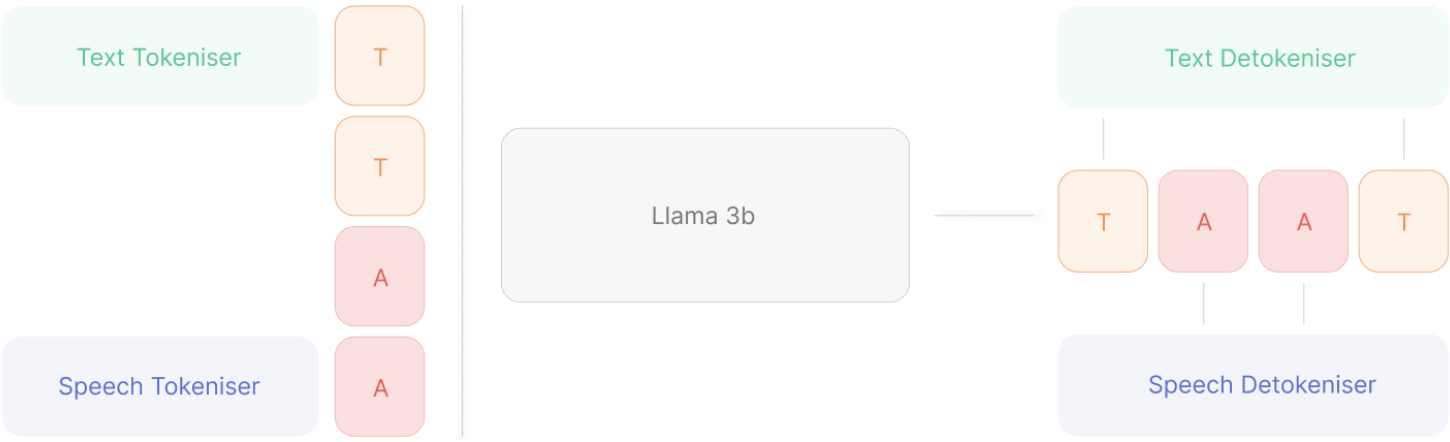
1) Decoupling the LLM and the decoder
Rather than treating Orpheus TTS as a monolith, Simplismart runs the LLM and decoder as modular, pipelined stages. This enables:
- Independent scaling (neither stage becomes a bottleneck)
- Parallel execution (decode while tokens are still being generated)
- Targeted optimizations per stage
This modularity is foundational as it avoids the traditional latency-vs-cost trade-off seen in end-to-end TTS stacks.
2) High-performance LLM serving for speech generation
The speech LLM is served using purpose-built model servers optimized for multimodal workloads, with the following characteristics:
- Adaptive, continuous batching: Requests join ongoing batches mid-generation, maximizing GPU utilization without padding overhead.
- Mixed-size tensor coalescing: Efficiently groups variable-length sequences, preserving latency while boosting throughput.
- Memory-efficient attention and KV management: Long prompts or dialogues do not degrade performance.
In practice, this allows the 3B-parameter speech LLM to generate audio tokens at real-time rates across many concurrent streams.
3) Decoder optimization: compilation, quantization and batching
The decoder (responsible for turning tokens into sound) is optimized aggressively to ensure it never throttles the pipeline:
- Ahead-of-time compilation: The decoder is compiled to optimized GPU code paths, eliminating Python overhead and maximizing kernel efficiency.
- Quantization: The decoder’s key–value (KV) cache is quantized to FP8, significantly reducing memory bandwidth and cache footprint while preserving audio fidelity and enabling higher concurrency per GPU.
- Adaptive micro-batching: Small token chunks from many live streams are batched together, amortizing overhead without adding delay.
Crucially, decoding is fully streaming: as soon as a few tokens are available, audio frames are produced and sent to the client while the LLM continues generating the next tokens in parallel.
Building real-time voice applications with Orpheus TTS
Achieving low latency with Orpheus TTS requires attention beyond the model itself.
Streaming APIs
Simplismart exposes streaming inference via HTTP chunked responses and WebSockets. Audio bytes (with headers) are streamed immediately with no buffering of the full waveform so playback begins as soon as the first frames are decoded.
Client best practices
- Reuse persistent connections (HTTP sessions or WebSockets)
- Avoid per-request handshake overhead (often 100 ms+)
- Stream and play audio incrementally
Reference clients handle chunking and buffering correctly, ensuring the application experiences the same low latency seen in benchmarks.
Voice quality and control
Orpheus TTS supports multiple voices, emotional styles, and zero-shot voice cloning. Simplismart’s API exposes these controls cleanly, without material impact on latency delivering expressive, natural speech alongside real-time responsiveness.
What this enables in production
On a single H100 (half-GPU), teams can expect:
- ~16+ concurrent live streams under variable traffic
- ~25+ concurrent streams with stable load
These capabilities make Orpheus TTS on Simplismart the most suitable choice for voice agents, call-center automation, interactive avatars, and large-scale content pipelines. Orpheus TTS can be deployed in Simplismart’s cloud, private cloud, or on-prem environments, with rapid auto-scaling and multi-cloud support.
Conclusion
By combining Orpheus’s LLM-driven speech quality with Simplismart’s modular, high-performance inference stack, teams can deploy voice AI that is both remarkably human-like and truly real time. Decoupling the LLM and decoder, compiling and quantizing the decoder, and using adaptive batching optimized for voice workloads are what make this possible at scale, and at sustainable cost.
Ready to take Orpheus TTS from experiment to production? Deploy it on Simplismart to build natural, real-time voice experiences, and contact us to customize your deployment for production scale.