
Two years ago, in our Series A letter, I wrote that one size does not fit all in AI inference. Today, that principle shows up in the economics of every deployment.
Getting a model to work is only the beginning. It has to make economic sense in production without asking customers to compromise on the experience or give up control over where it runs.
Your workload should dictate your infrastructure. Not the other way around.
That is what we’re building at Simplismart, and today we’re announcing a $14 million Series B led by Dallas Venture Capital, with participation from NVIDIA, Accel, Shastra VC, and Micromax. Our software helps application companies run AI within their cost, performance, and deployment requirements, and enables cloud providers to turn GPU capacity into managed AI services under their own brands.
Over the past six months, our annualized revenue run rate has grown 14x. Companies including HeyGen, Higgsfield, InVideo, Shiprocket, Apna and Ema are running production workloads on Simplismart across video, voice, multimodal and enterprise AI. That growth reflects the problem we set out to solve: making AI applications work commercially, under real production demands.
Inference is a spectrum, not a leaderboard.
A voice agent can give the right answer and still lose the user if it takes too long to respond. Waiting breaks the flow. An overnight document-processing job, on the other hand, can tolerate delays if they bring the cost down. Even the same model can need a different setup depending on what the customer is trying to accomplish.
Underneath the endpoint is a stack of engineering decisions: hardware, precision, batching, caching, kernels, and scheduling. None happens in isolation. Larger batches can improve throughput while making individual requests wait longer. Lower precision can reduce compute requirements but affect quality.
Winning on one metric isn’t enough. The useful question isn’t “which configuration wins?” It’s “which configuration meets this application’s requirements, under its real traffic, at a cost the business can sustain?”
For our customer Ema, the target was roughly 200 milliseconds of latency at about nine cents per million tokens. One configuration came in at five cents but took 350 milliseconds. Another reached 100 milliseconds but cost 12 cents. We delivered a production configuration at seven cents and 180 milliseconds, meeting both requirements. That is what useful optimization looks like: finding a configuration the application can actually run on, within the economics the business needs.
That’s why we think of inference as a spectrum, not a leaderboard. Our modular inference engine configures the serving stack around the workload. Our orchestration platform gets it into production and manages capacity as demand changes. We take the infrastructure work off our customers’ plates without taking the important choices out of their hands.
Voice agents bring a different set of constraints. Exotel post-trained an open-source model on its own data and used Simplismart to run inference. In a comparison of the same workload, our managed inference brought costs to ₹0.90–₹1.30 per minute, versus ₹2.10 for the closed-model API setup, approximately 38–57% lower. That is roughly 0.94–1.36 US cents per minute, compared with 2.20 US cents. The comparison also reports latency below 300 milliseconds, versus 1.1 seconds for the closed-model setup. By allocating workloads a fraction of a GPU rather than an entire GPU, we helped bring the application’s cost and performance requirements together.
Different workloads define success differently, and the infrastructure should be built around that.
Available compute isn’t ready compute
Finding the right configuration is only the beginning. It still has to work when demand changes.
A GPU can be available without the model being loaded and ready to serve requests. Scaling too late leaves users waiting. Keeping enough capacity ready for peak demand protects response time, but can mean paying for idle compute when traffic falls.
On-demand compute is, in my view, the biggest unsolved problem in inference. The challenge is having the right model ready when demand arrives without paying for peak capacity around the clock. That is why optimization and operations have to work together. There is no final tuning pass.
Our work with NVIDIA
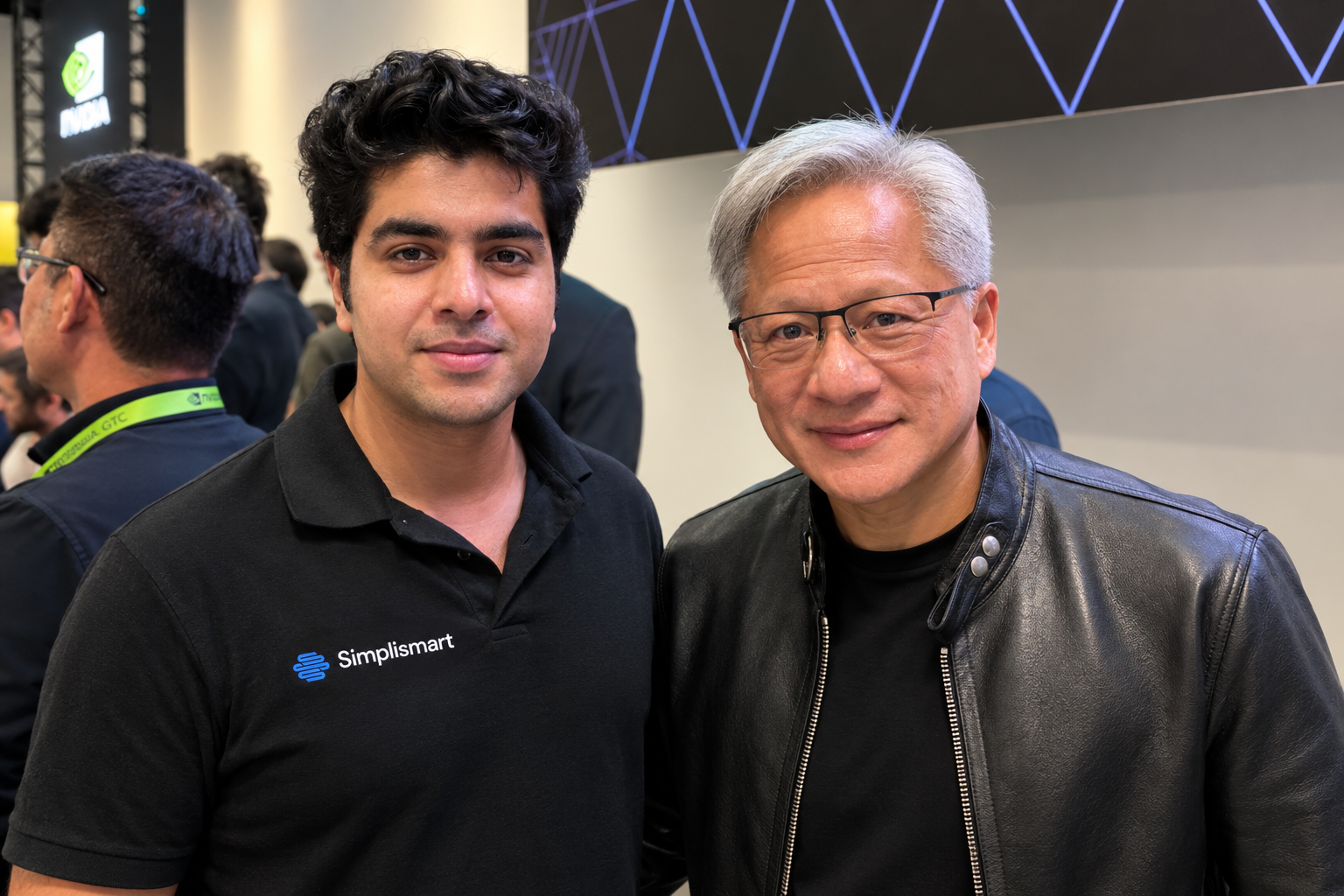
Our engineering team works directly with NVIDIA Solutions Architects, with technical contributions coordinated between the teams. NVIDIA also helps facilitate relevant industry connections as we expand our work with enterprises and cloud providers.
This collaboration supports the work described throughout this letter: making AI infrastructure easier to deploy and operate at scale. We’re pleased to have NVIDIA participating in this round as we continue building the software that turns GPU capacity into useful production services.
We build the software, not the GPU fleet.
We made a deliberate choice to build the software that turns third-party GPU fleets into production AI services, rather than build a GPU fleet ourselves. Application companies use our platform to run their products. Cloud providers use it to offer managed AI services under their own brands.
I believe every data center will eventually be an AI cloud. But racks of GPUs are not a product. A cloud provider needs a way to turn that capacity into services its customers can actually buy, with the reliability and economics an enterprise expects.
This is the software behind what we call AI token factories: turning GPU capacity into services for running models, under the provider’s own brand.
At Yotta, Simplismart powers the serverless inference layer of Shakti Studio, so its customers can run AI models without managing the infrastructure underneath.
Sovereignty isn’t a slogan here. It’s a deployment requirement. Enterprises and governments want control over where their models run and where their data lives. That may mean working within a chosen cloud or operating on-premises. Open weights give them more deployment choices; our software helps make those choices practical, including in private environments. Simplicity shouldn’t mean giving up control.
The next problem: idle GPUs here, missing capacity there
Making individual models run better is what we’ve spent four years on. The bigger problem ahead is matching unpredictable demand with fixed supply.
A consumer app peaks at lunch and goes quiet overnight. Batch jobs run at 2 a.m. Cloud providers sell GPUs through long-term commitments, while customers want to pay only for what they use. The result is a strange mismatch: GPUs sit idle in one region while customers struggle to find capacity in another.
We’re building toward a dynamic scheduling layer that matches demand with suitable capacity across regions and time zones. This isn’t just shipping work to wherever a GPU happens to be idle. The capacity has to meet the application’s response-time needs without crossing the customer’s data-residency or compliance boundaries. Getting that right across the world’s GPU supply is the problem worth solving.
Working with application teams gives us insight into demand. Working with cloud providers gives us insight into available capacity. Bringing those perspectives together is the next step: matching workloads with capacity they can actually use, within the customer’s deployment requirements. That is the network we’re building toward.
Where the money goes
This funding lets us go deeper on the inference engine and orchestration platform, while expanding the cloud partnerships that bring our software to more customers. North America is a priority as we grow globally.
Cheaper, faster inference can make an AI product viable, not just shrink its bill. That is why I see efficiency as a driver of growth for this market.
Thank you to Dallas Venture Capital for leading, and to NVIDIA, Accel, Shastra VC and Micromax for backing us. Our customers trust us with workloads their businesses depend on, and our team does the unglamorous engineering that earns that trust. I’m grateful to everyone building this with us.
Devansh and I started Simplismart because we were tired of fighting production pipelines. Four years later, we’re taking that work beyond individual applications to the cloud providers serving them. Better models keep expanding what AI can do. We’re building the infrastructure that makes more of it worth doing.
If you’re building an AI product or turning GPU capacity into a managed service, let’s talk.
Amritanshu
Co-founder & CEO