
TL;DR
- Meta's first open-weight Muse model: 816B total, ~42B active, 1M context, text, image, video and audio in.
- #1 US open-weights model on the Artificial Analysis Intelligence Index. Leads open peers on tool-calling agents, factual reliability and image questions. Trails Kimi K3 and GLM 5.3 on coding agents.
- Hybrid attention cuts the KV cache 3.7× at 128K. NVFP4 weights (~530 GB) fit one 8-GPU or 4× GB300 node.
- Fast on hosted APIs: 102 tokens/s and 0.67 s to first token.
Most B2B AI features today run on closed APIs. You rent a model by the token, send your data out, and accept whatever version the vendor ships. Open models have been the alternative, but they lagged on agent work. Meta’s Muse Spark Open closes much of that gap. It is strongest at three things B2B products depend on:
- Agents that call your tools and APIs
- Answers drawn from long documents
- Inputs like screenshots, PDFs and calls
This post covers where it wins, where it falls short, and what it takes to run.
What is Muse Spark Open?
Meta co-trained it with Muse Code, its coding agent, and positions it for long-horizon agent work. Details in Meta's launch post and developer guide.
Where does it sit in Meta's lineup?
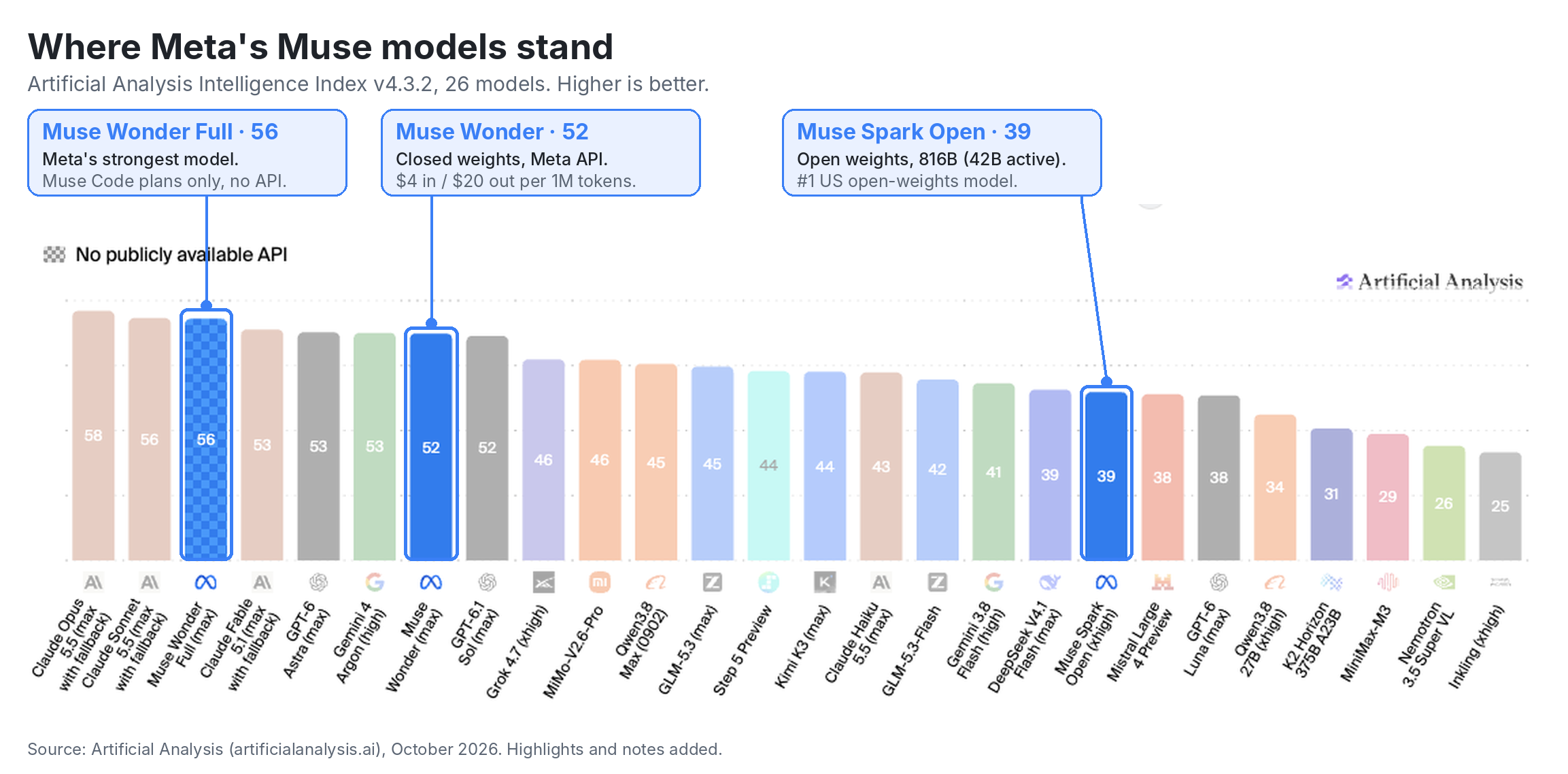
Benchmark performance
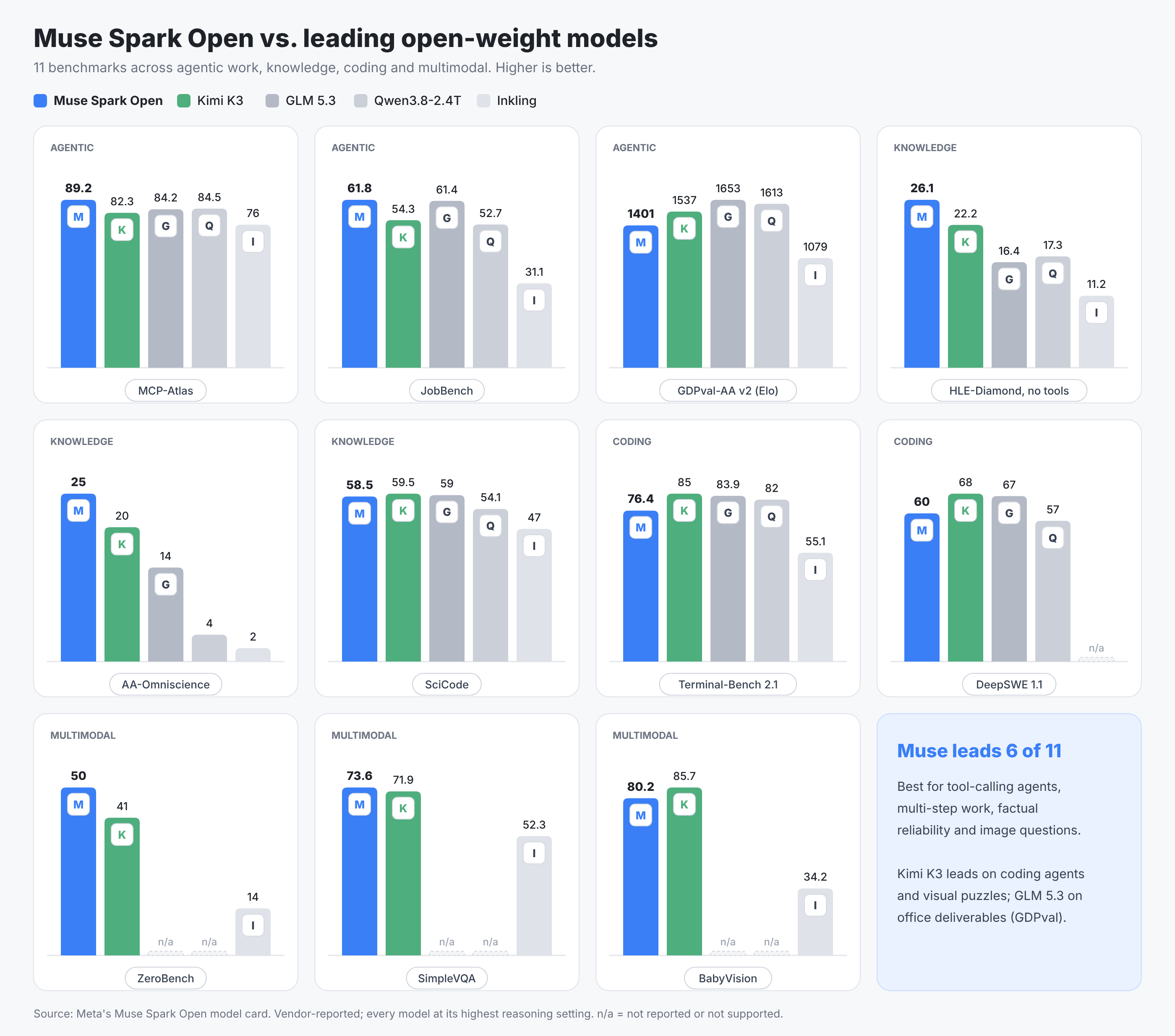
Key numbers
- What it’s best at: using your tools and apps, giving correct answers instead of guessing, and understanding images. It scores highest among the open models Meta compared on tool use (89.2 on MCP-Atlas, 4.7 points ahead), expert questions (26.1 on HLE-Diamond vs 22.2), factual accuracy (25 on AA-Omniscience) and image questions (50 on ZeroBench vs 41).
- Where others do better: writing and fixing code on its own, and producing polished documents. Kimi K3 leads on coding (85.0 vs 76.4 on Terminal-Bench; 68 vs 60 on DeepSWE), and GLM 5.3 leads on office work (1653 vs 1401 on GDPval).
- Overall: on Artificial Analysis’s combined score, it gets 39, just behind GLM 5.3 (45) and Kimi K3 (44). Pick it for specific jobs, not as an all-rounder.
Scores are vendor-reported at each model's highest reasoning setting, with different harnesses per benchmark.
What's new in the architecture?
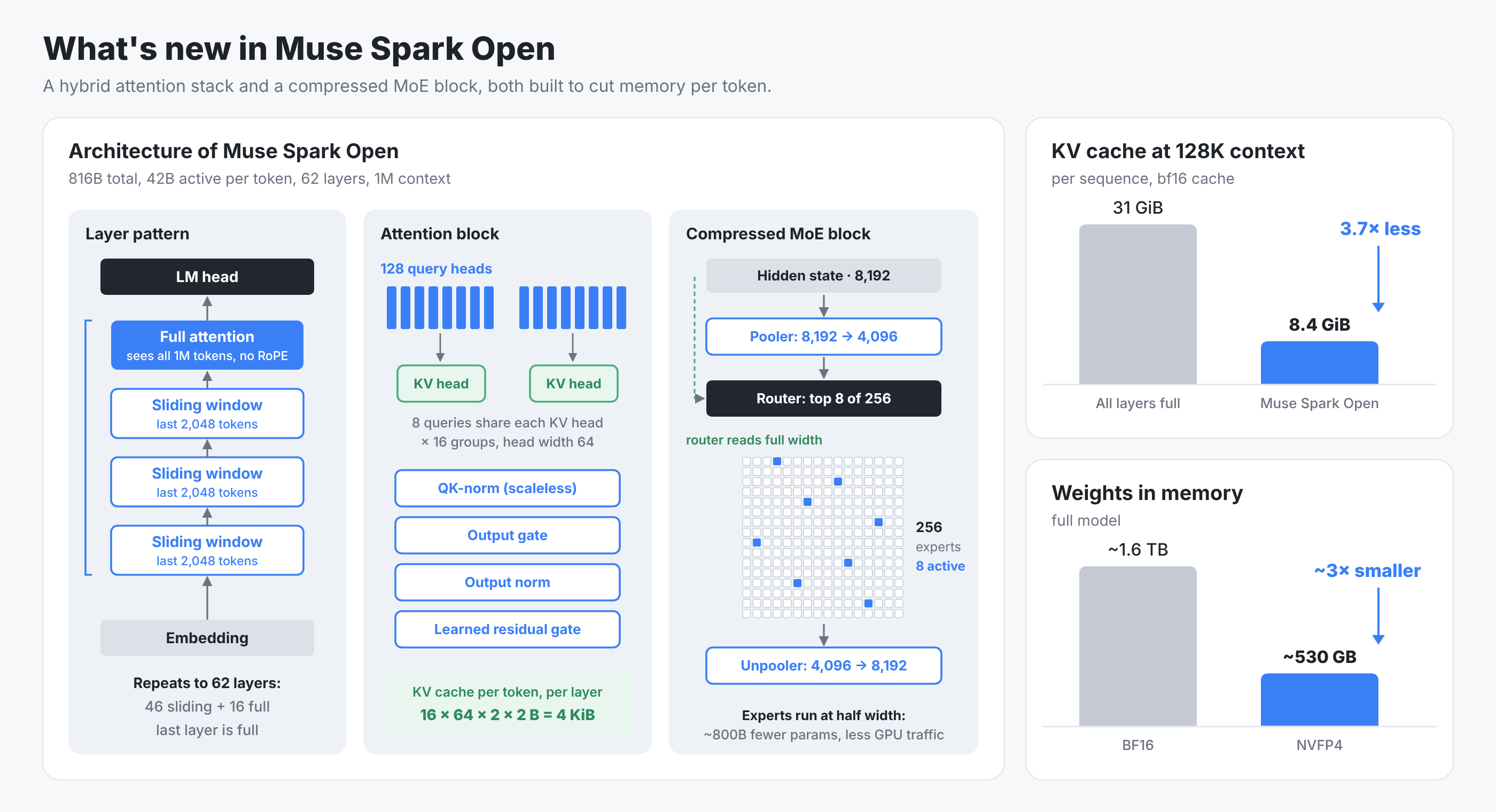
- Hybrid attention. 46 layers see only the last 2,048 tokens. 16 full-attention layers, with no RoPE, see the whole context. KV cache at 128K drops from 31 GiB to 8.4 GiB per sequence.
- Narrow, shared KV heads. 128 query heads over 16 KV heads of width 64: 4 KiB per token per layer.
- Compressed MoE. A pooler shrinks the stream to 4,096 before the experts and an unpooler restores 8,192. Each expert is half the size, the model is ~800B parameters smaller than an uncompressed design, and less data crosses GPUs. The router still reads the full width.
- Stabilizers. Scaleless QK-norm, an output gate and norm, and a learned residual gate.
What does it take to deploy?
Estimated memory requirements
KV cache scaling for 1M context
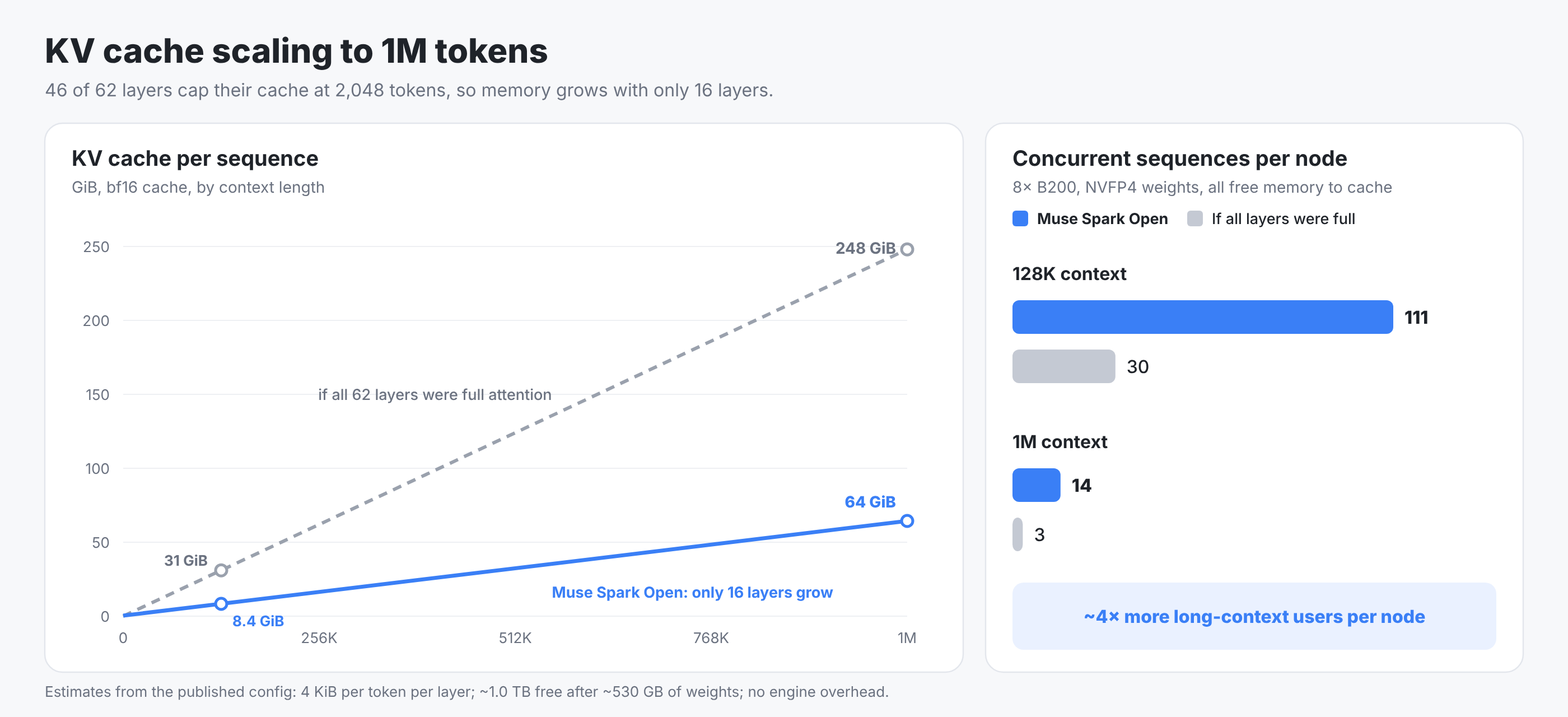
- Per sequence: 64 GiB at 1M tokens, against 248 GiB if every layer were full attention.
- Per 8× B200 node: about 111 sequences at 128K and 14 at 1M, against 30 and 3.
Speed
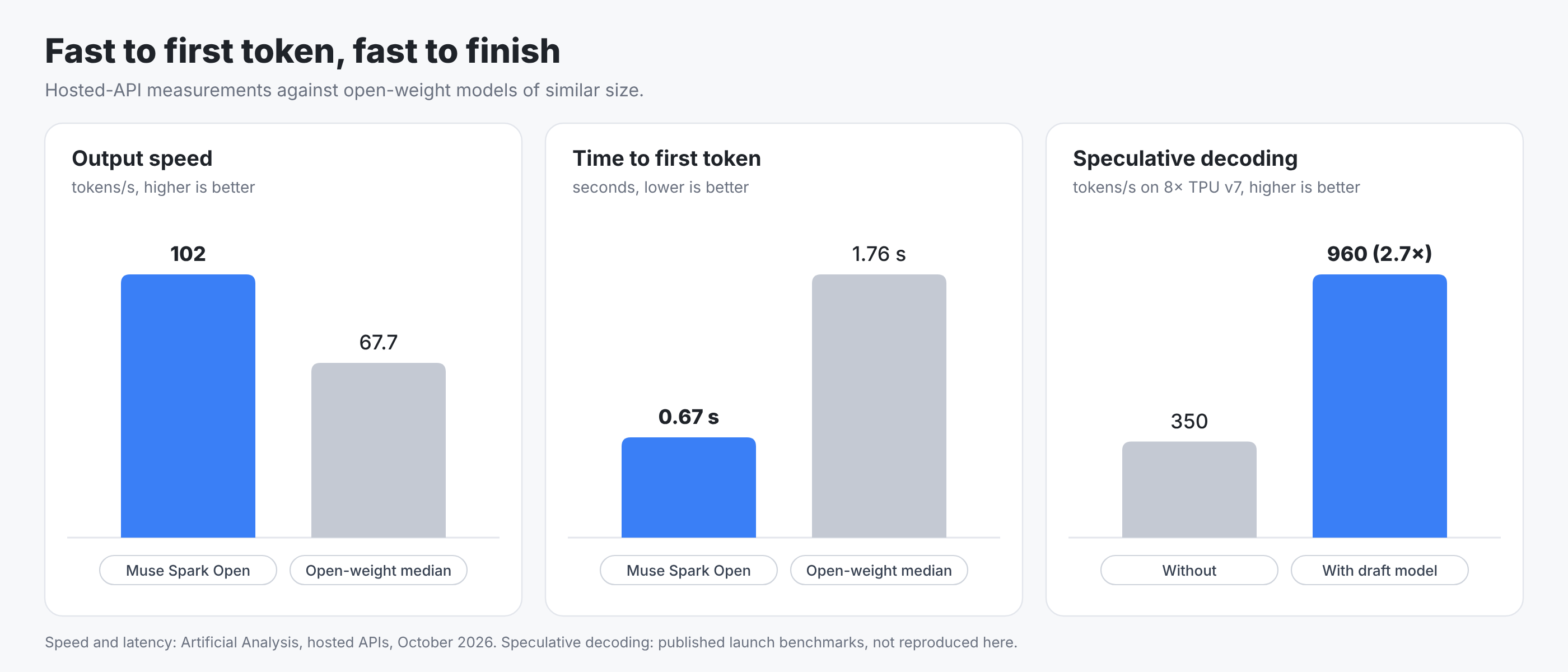
- Hosted APIs: 102 tokens/s and 0.67 s to first token, against open-weight medians of 67.7 tokens/s and 1.76 s (Artificial Analysis).
- Speculative decoding: Muse ships with small draft models that predict several tokens ahead for the main model to verify in one pass. Launch benchmarks report 2.7× to 3.7× higher throughput, with the gain shrinking under heavy load (3.7× for one request vs 2.9× at 16).
Practical deployment considerations
- Sliding-window allocation. The 3.7× cache saving holds only if the 46 sliding layers are capped at 2,048 positions.
- Expert parallelism. With 256 experts and top-8 routing, expert placement and GPU-to-GPU bandwidth set throughput more than raw FLOPs.
- Reasoning effort. Meta's scores use the highest effort, which means more output tokens per answer. Tune effort per workload.
- Draft acceptance. Speculative decoding gains depend on your prompts. Measure acceptance on real traffic.
- Price. Hosted APIs charge $1.25 per 1M input tokens and $4.25 per 1M output. That’s about 3× the median for open-weight models of this size ($0.43 / $1.59). Because the weights are open, you aren’t tied to that price: the same model can run on any provider or in your own cloud.
- License. Muse Model License comes with limited commercial terms. Internal use and use inside your own product are allowed. Reselling the model as an API needs a Meta agreement past $20M in annual revenue.
Savings only show up when your inference stack is set up right
Muse Spark Open is built to be cheap to run: 42B active parameters per token, a sliding-window cache, and a draft model for speculative decoding. But the inference stack has to use them. If the engine doesn’t cap the sliding layers at 2,048 positions, the cache grows like a dense model’s. If experts are badly placed across GPUs, every token waits on all-to-all traffic. If speculative decoding is tuned on a benchmark instead of your prompts, the speedup never arrives.
There’s no single right setup either. A coding agent that needs fast first responses, a document pipeline with long inputs, and a support bot with spiky traffic each need different batching, precision, parallelism and scaling from the same model.
That’s what Simplismart does: instead of one generic API, we tune the inference stack to each workload, on our cloud or inside your own AWS, GCP or Azure account. We already run large open-weight mixture-of-experts models like NVIDIA Nemotron 3 Ultra this way in production.
Muse Spark Open is available on Simplismart in beta, alongside 150+ open-source models. If you’re evaluating it, tell us about your workload and we’ll help you plan how to run it well.
Summary
Muse Spark Open is the strongest open model a US lab has shipped, and the best open choice today for tool-calling agents, factual answers and image-heavy inputs. It is not the leader on coding agents. Its real advantage is efficiency: 42B active parameters, a KV cache a quarter the usual size, and 4-bit weights that fit one node, which makes 1M-token workloads affordable to run.
Frequently asked questions
Can you use Muse Spark Open commercially?
Yes, in most cases. Internal use and use inside your own product are allowed. Selling the model as an API needs a Meta agreement once that business passes $20M in 12-month revenue. Products must show "Built with Muse Spark Open".
Does speculative decoding still speed up Muse Spark Open under heavy load?
Yes, but less. One reported setup drops from 3.7× at a single request to 2.9× at 16 concurrent requests. Measure at your real load.
Can Muse Spark Open run on 8× H100?
Not comfortably. 8× H100 has 640 GB and the NVFP4 weights take about 530 GB. Meta recommends at least 700 GB of GPU memory, such as 8× H200 or 4× B300.
Does the 2,048-token sliding window limit what Muse Spark Open remembers?
No. Its 16 full-attention layers read the full 1M-token context. The window only caps what the other 46 layers cache.
Is DSpark the same as multi-token prediction (MTP)?
No. MTP heads predict extra tokens from the model's own hidden state. DSpark is a separate draft model that proposes a block of tokens in one pass.
Does Muse Spark Open reserve 1M tokens of cache for every request?
No. Cache grows with each conversation: a 32K-token request needs about 2.4 GiB. Capping the maximum context length frees memory for more users.
Is the Muse Spark Open NVFP4 checkpoint fully 4-bit?
No. Only the experts are 4-bit. Attention and the first- and last-layer experts stay in BF16, so the checkpoint is about 530 GB, not about 460 GB.
Can you turn off reasoning in Muse Spark Open?
No. The lowest effort is low, and none is rejected. Reasoning shares max_tokens with the answer, so leave headroom or the answer can come back empty.