

TL;DR
- Moonshot's post-trained upgrade of Kimi K3: 2.8T total, 104B active per token, 1M-token context, text and image in. Released October 23, 2026; open weights on Hugging Face in early November.
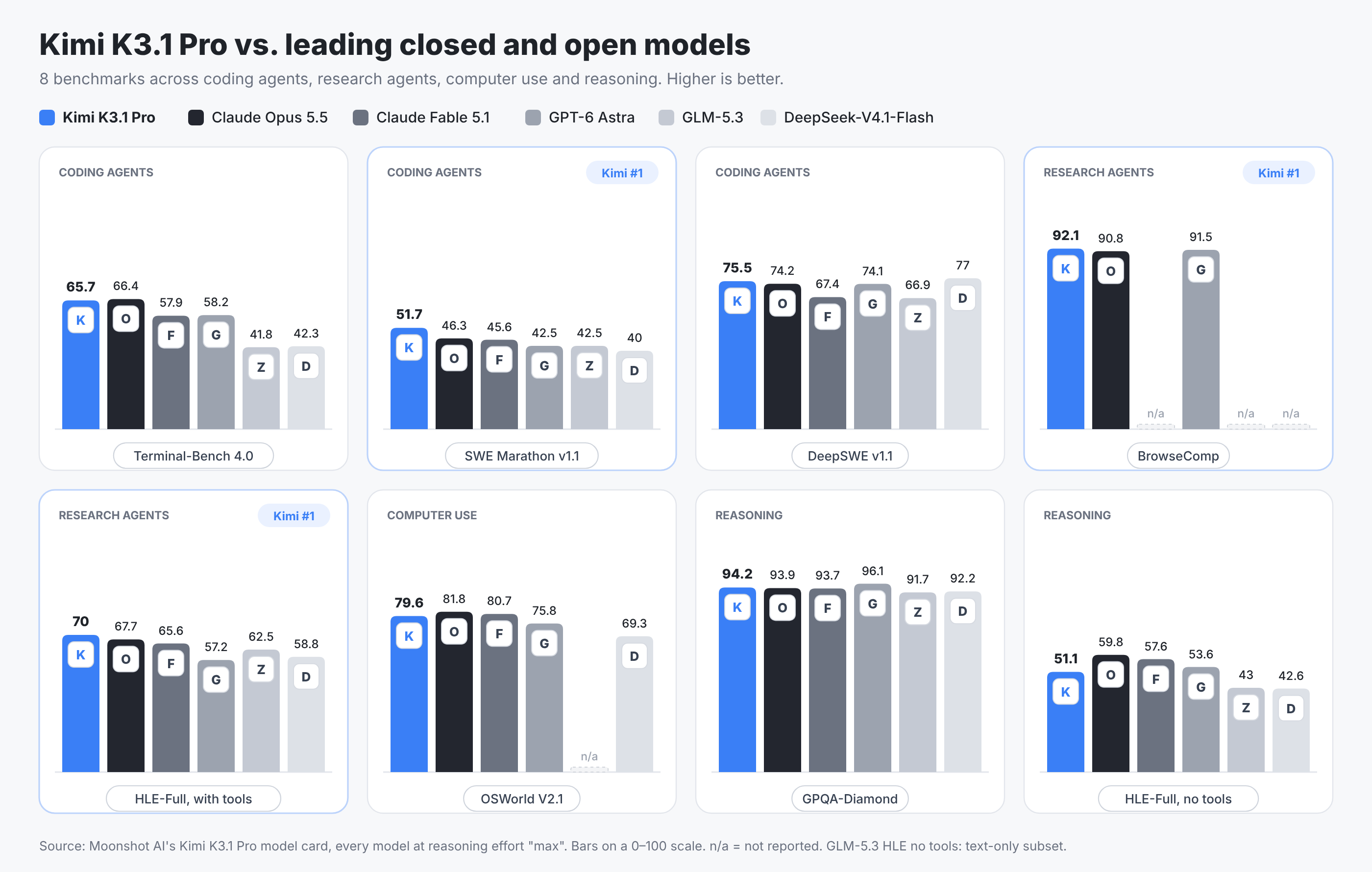
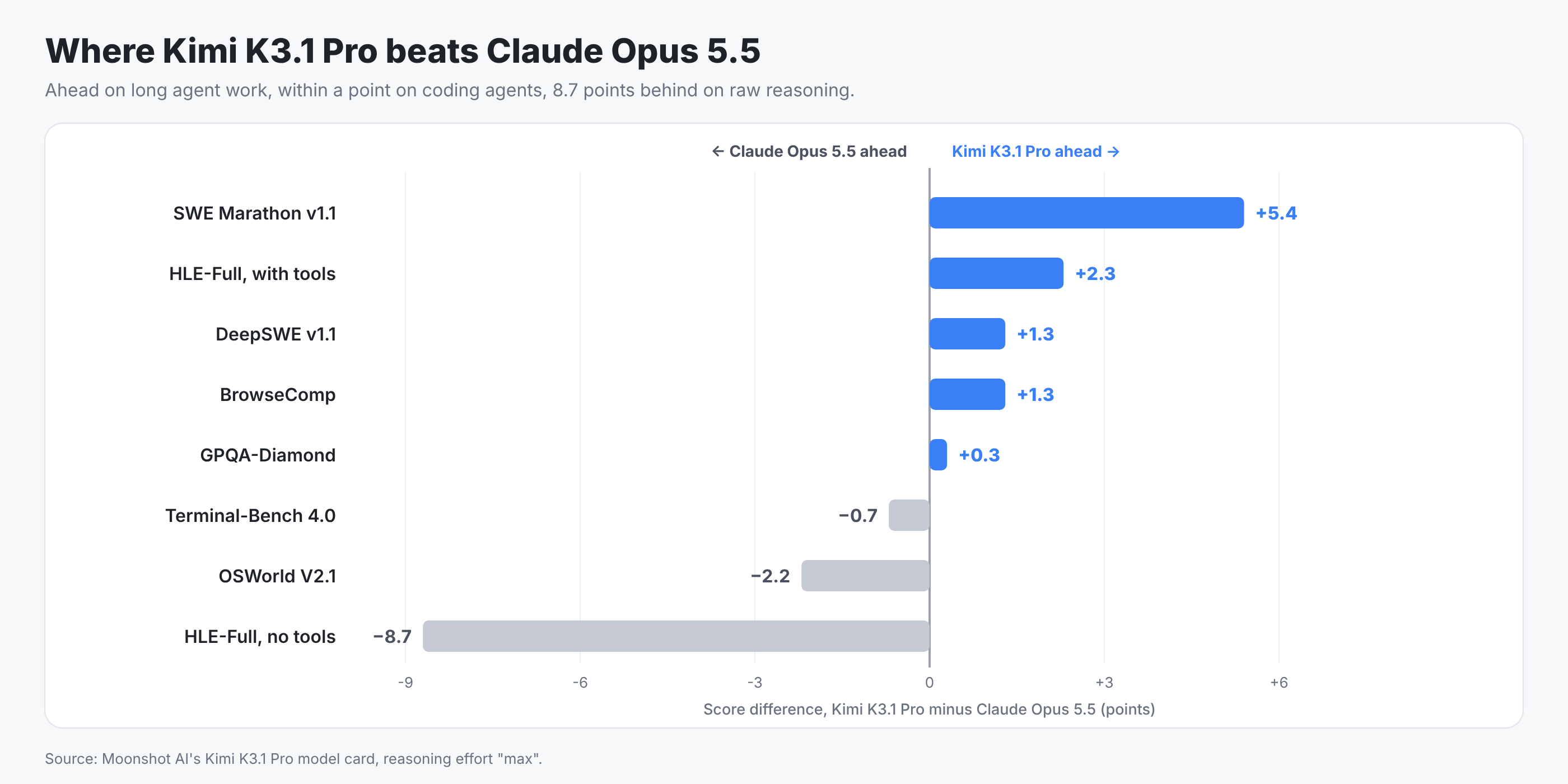
- Close to Opus 5.5 on coding agents, ahead of it on SWE Marathon (51.7), BrowseComp (92.1) and HLE with tools (70.0). Trails it by 8.7 points on HLE without tools.
- Hybrid attention (69 KDA + 24 Gated DSA layers) keeps a 1M-token window affordable. MXFP4 weights (~1.56 TB) need about 1.68 TB of GPU memory, such as 8× B300.
- Thinking is always on. Live in beta on Simplismart, on our cloud or inside yours.
Most teams building coding agents and research agents run them on closed APIs today, because open models have trailed on long, multi-step work. Kimi K3.1 Pro closes most of that gap. This post covers what changed from Kimi K3, where it wins and loses, how the architecture keeps 1M tokens servable, and what it takes to run.
What is Kimi K3.1 Pro?
It is the first model in the K3.1 series. Moonshot took Kimi K3, released in July 2026, and trained it further with reinforcement learning across hundreds of task types. Weights are on Hugging Face.
What changed from Kimi K3?
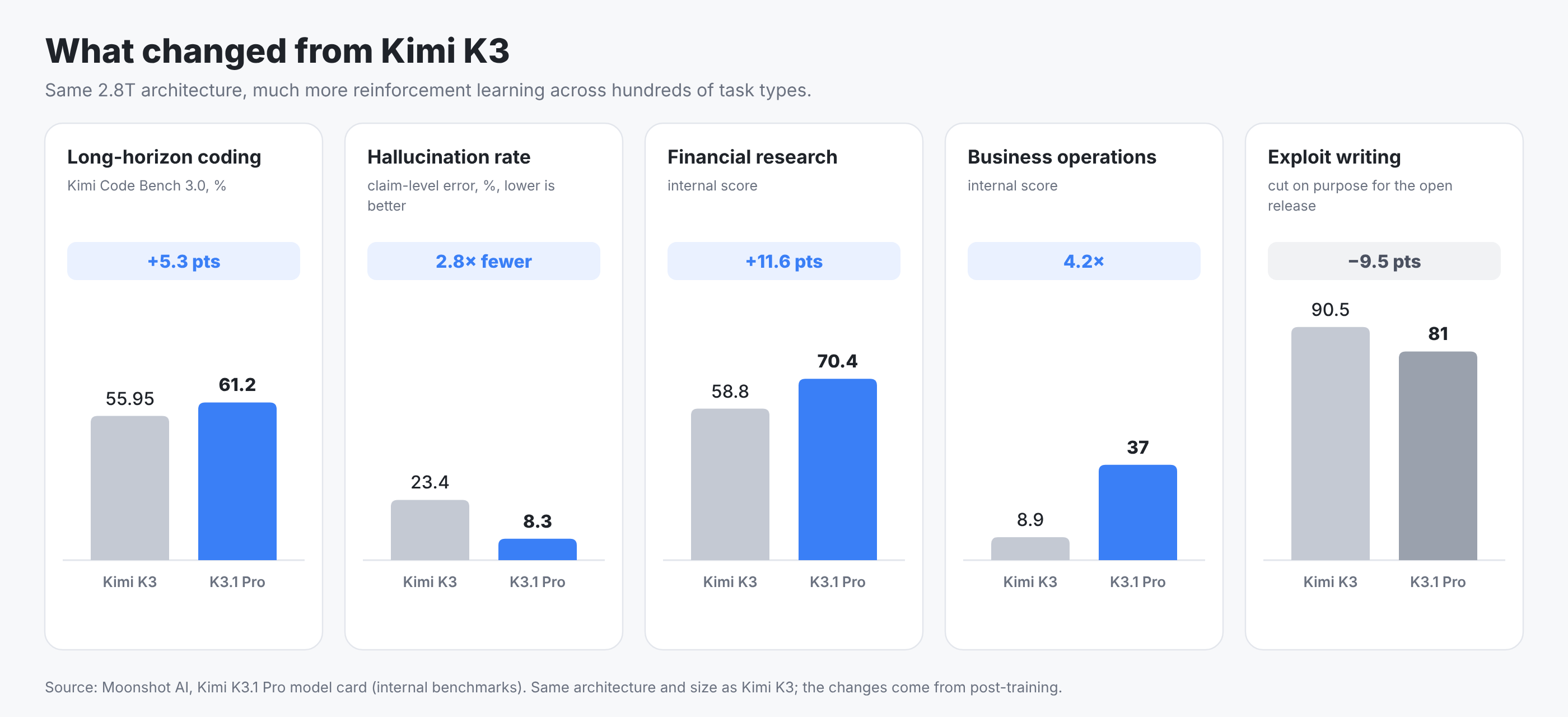
- Better at long coding work. Kimi Code Bench 3.0 rose 5.3 points. Vals AI saw the same direction on Terminal-Bench 4.0.
- Fewer made-up facts. Claim-level errors fell from 23.4% to 8.3%, which matters most for research and finance.
- Office and analyst work. Business operation tasks went from 8.9 to 37.
- 3D and CAD. It drives Blender, Unreal, Godot and CAD tools: 92.7 on BenchCAD with tools.
- A Highspeed variant. 2–3× faster on Moonshot's API.
- Weaker at hacking, on purpose. Moonshot removed cyber-attack data from the open release.
Benchmark performance
Key numbers
- Coding agents: Terminal-Bench 4.0 65.7%, 0.7 behind Opus 5.5 and 24 ahead of GLM-5.3.
- Long coding tasks: SWE Marathon 51.7, best in the table.
- Research agents: BrowseComp 92.1 and HLE with tools 70.0, both best in the table.
- Computer use: OSWorld V2.1 79.6, behind both Claude models.
- Trails on raw reasoning: HLE without tools 51.1 vs 59.8 for Opus 5.5; HLE-Diamond 39.4 vs 60.9.
- Trails DeepSeek on one row: DeepSWE 75.5 vs 77.0.
Scores are vendor-reported at reasoning effort "max". Independent testing broadly agrees: Vals AI measured 63.64% on Terminal-Bench 4.0 through Moonshot's API, #3 of 55 models. Vals also found it weaker than Kimi K3 on legal and tax tasks, so test it on your own workload.
What's in the architecture?
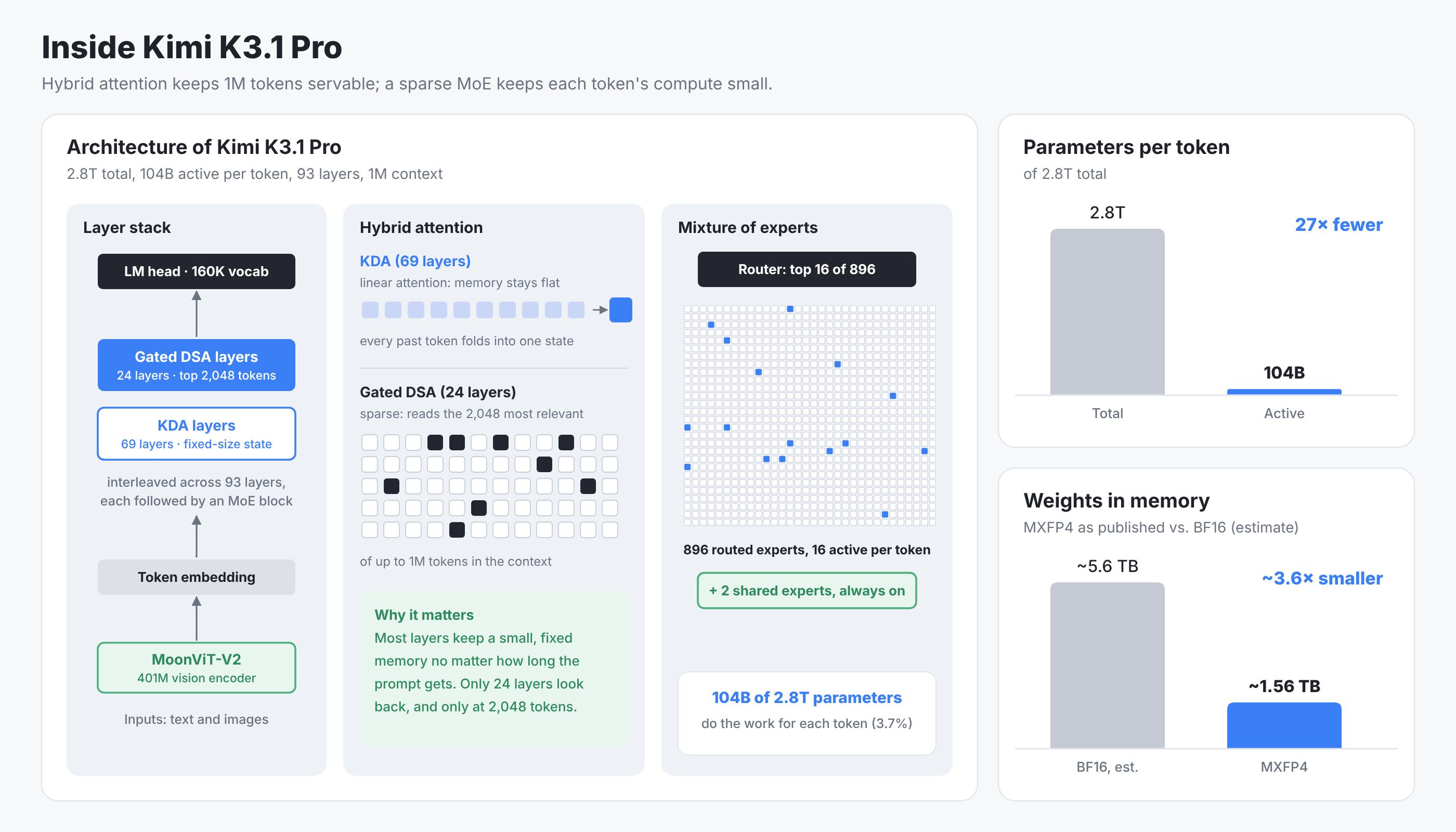
- Kimi Delta Attention (69 layers). Linear attention: past tokens fold into a fixed-size state, so these layers' memory stays flat as the prompt grows.
- Gated DSA (24 layers). Sparse attention that reads only the 2,048 most relevant tokens. Together with KDA, this is what keeps a 1M-token window affordable to serve.
- Sparse MoE. 16 of 896 routed experts plus 2 shared experts run per token: 104B of 2.8T parameters, about 3.7%. Compute per token is small. Memory is not: all 2.8T still sit in GPU memory.
- Native MXFP4. Moonshot trained quantization-aware, so the 4-bit weights are the full-quality model, not a lossy copy. Activations run in MXFP8.
- Vision in. A 401M-parameter MoonViT-V2 encoder takes images alongside text.
What does it take to deploy?
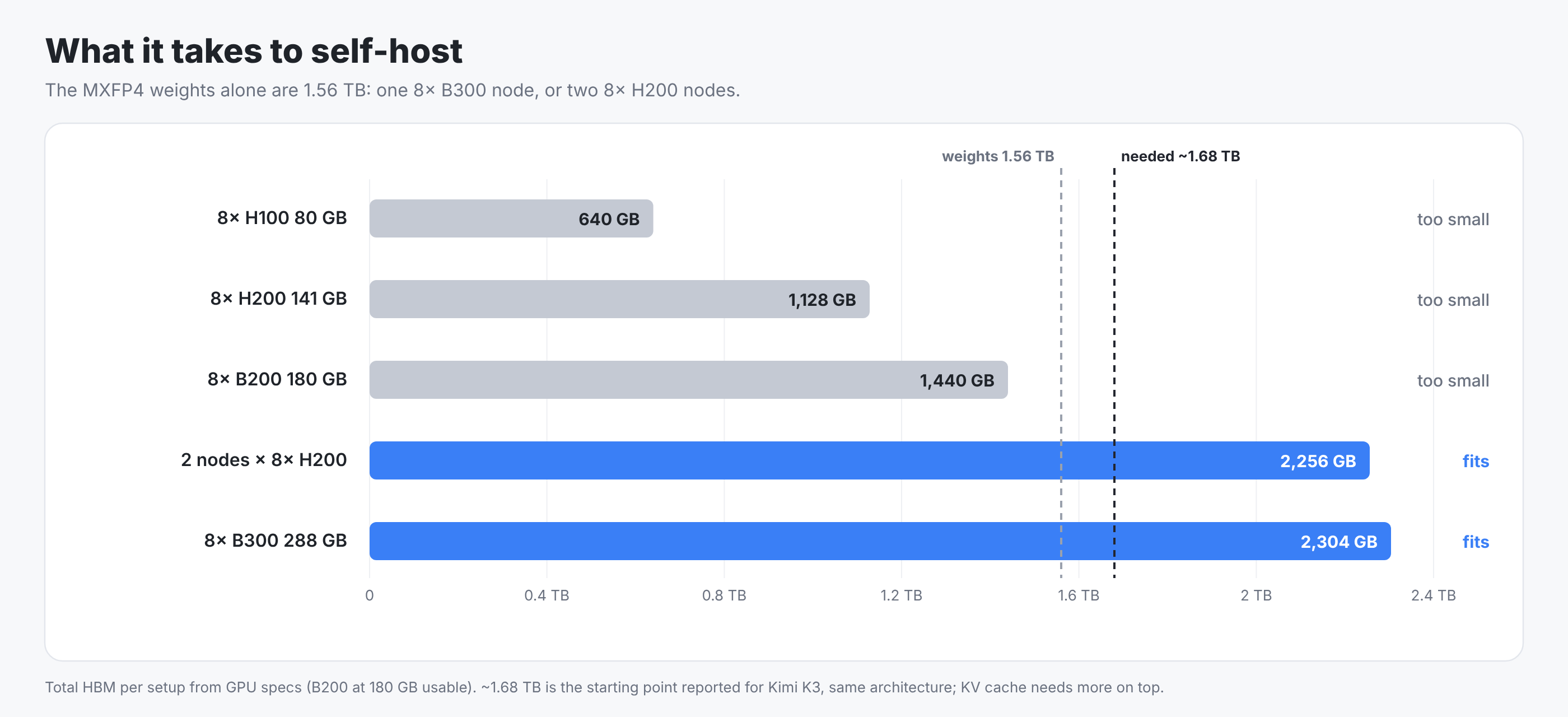
- Memory: the weights take about 1.56 TB, and Kimi K3 on the same architecture needs roughly 1.68 TB of GPU memory as a starting point. That rules out any single H100, H200 or B200 node.
- Speed: depends on how the model is split across GPUs. Moonshot's Highspeed variant runs 2–3× faster on its own API.
Practical deployment considerations
- Thinking is always on. Default effort is "max", so answers run long and the first reply is slow. Drop to "high" or "low" where the task allows; real cost per task tracks output tokens, not list price.
- Fixed sampling. Temperature 1.0 and top_p 0.95 are fixed. Leave them out of requests.
- Expert parallelism. With 896 experts across many GPUs, expert placement and GPU-to-GPU bandwidth set throughput more than raw FLOPs.
- Long context. The hybrid attention keeps 1M tokens servable, but only if the engine allocates cache per layer type. Cap context length to what the workload needs.
- License at scale. API resellers above $20M a year need a Moonshot agreement, and products above 100M monthly users or $20M monthly revenue must show the "Kimi K3.1-Pro" name. Internal use and certified inference partners are exempt.
Inference is where Kimi K3.1 Pro gets expensive
Kimi K3.1 Pro is built to keep each token cheap: 104B active parameters, linear attention in most layers, and native 4-bit weights. The inference stack has to use all three. If experts are badly placed across nodes, every token waits on GPU-to-GPU traffic. If the engine treats every layer like full attention, long prompts eat the memory that should serve more users. If reasoning effort stays at "max" for every request, output tokens and cost climb with it.
There is no single right setup either. A coding agent that needs fast first replies, a research agent reading long documents, and a batch pipeline over a codebase each need different parallelism, batching and effort settings from the same model.
That's what Simplismart does: instead of one generic API, we tune the inference stack to each workload, on dedicated GPUs, on our cloud or inside your own AWS, GCP or Azure account, so prompts and data never leave your environment. Simplismart is SOC 2, ISO 27001, GDPR and HIPAA compliant.
Kimi K3.1 Pro is live in beta on Simplismart. Get beta access and we'll help you plan how to run it well.
Summary
Kimi K3.1 Pro is the strongest open-weight model for long agent work today: best in Moonshot's table on long coding tasks and web research, and within a point of Claude Opus 5.5 on coding agents. It still trails the top closed models on reasoning without tools. Its cost is size: 1.56 TB of weights that need a multi-GPU cluster before the first request.
Frequently asked questions
1. Is Kimi K3.1 Pro open source?
It is open-weight, not fully open source. The weights are on Hugging Face under an MIT-style license that allows use, modification and fine-tuning. Training data and training code are not released.
2. Can Kimi K3.1 Pro run on 8× H100 or 8× H200?
No. 8× H100 has 640 GB and 8× H200 has 1,128 GB, below the 1.56 TB of weights. You need about 1.68 TB, such as one 8× B300 node or two 8× H200 nodes.
3. Is Kimi K3.1 Pro better than Claude Opus 5.5?
On long agent work, often yes: it leads on SWE Marathon, BrowseComp and HLE with tools. On Terminal-Bench 4.0 it is 0.7 points behind. On HLE without tools it trails by 8.7 points. Unlike Opus, you can run it on your own GPUs.
4. Can you turn off thinking in Kimi K3.1 Pro?
No. Thinking is always on, and the default effort is "max". Set effort to "high" or "low" for shorter answers and faster first replies.
5. Is Kimi K3.1 Pro safe to use for business?
Yes, when you control where it runs. Host the open weights on your own GPUs or inside your cloud account, for example through Simplismart, and prompts never reach Moonshot. Moonshot's own API also offers zero data retention.
6. Is the MXFP4 checkpoint a lossy copy?
No. Moonshot trained the model quantization-aware for MXFP4, so the published 4-bit weights are the full-quality model.