

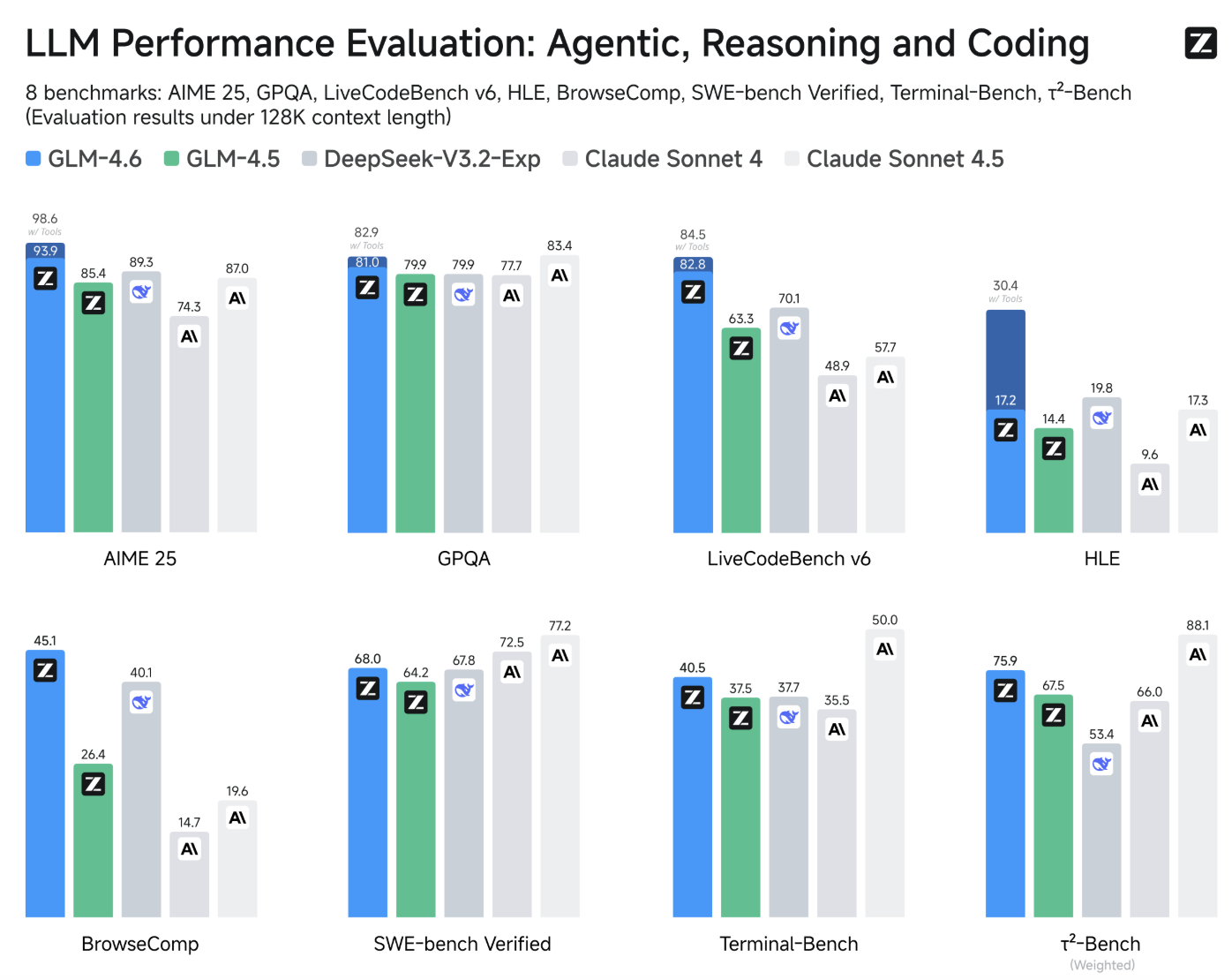
GLM-4.6 is a high-capacity LLM designed for strong reasoning and general-purpose generation, and it has quickly attracted attention from teams evaluating it for real-world enterprise workloads.
As usage moves beyond single-request demos, a practical question arises: how do you serve this model at scale while maintaining stable latency, high throughput, and controlling GPU costs?
This post explains how Simplismart optimizes GLM-4.6 inference on H100 GPUs using production-grade techniques such as FP8 execution, multi-token prediction, and high-throughput serving, achieving up to 142 tokens per second (TPS). We will also walk through the performance metrics that matter for LLMs in production and the system-level optimizations required to deploy GLM-4.6 reliably under real traffic.
Why GLM-4.6 Matters and Why Inference at Scale is Challenging
GLM-4.6 stands out for its strong reasoning capability and broad applicability across enterprise use cases, from internal copilots to high-volume API-driven systems. Its model capacity enables longer contexts and more reliable responses, which makes it attractive for production workloads that require consistency rather than single-shot demos.
That same capacity makes inference challenging at scale. GLM-4.6 places sustained pressure on GPU memory, memory bandwidth, and decode throughput, especially under concurrent traffic with mixed prompt lengths. Conventional FP16 inference and static batching approaches, which assume uniform request sizes and synchronous execution, quickly lead to poor GPU utilization, rising tail latency, and unpredictable performance as request volume increases.

Production Metrics That Matter for GLM-4.6 Inference
- Throughput vs. Latency Trade-offs for LLMs: For GLM-4.6, production performance is defined less by single-request latency and more by sustained throughput under concurrent load.
- Time to First Token (TTFT): Stable TTFT under concurrency is critical for perceived responsiveness, especially for chat and agent workloads.
- Concurrency and GPU Utilization Under Real Traffic: Mixed prompt lengths and overlapping requests require dynamic batching and efficient scheduling to avoid padding overhead and idle GPUs.
Why GLM-4.6 Requires High-Throughput Serving
GLM-4.6 inference operates as a continuous, overlapping workload rather than isolated requests. In production, requests arrive asynchronously with varying prompt lengths and decode times, requiring dynamic batching, efficient memory reuse, and scheduling that remains stable under concurrency. Without these capabilities, performance becomes bottlenecked by KV-cache growth, memory fragmentation, and scheduling overhead well before GPU compute limits are reached.
How Simplismart Optimizes GLM-4.6 Inference on 8× H100 GPUs
Deploying GLM-4.6 on Simplismart focuses on maximizing sustained throughput and predictable latency on modern GPU infrastructure.
Below is a detailed overview:
FP8 Inference on H100 for Memory and Bandwidth Efficiency
FP8 inference reduces memory footprint and memory-bandwidth demand compared to FP16, which is critical for serving large models like GLM-4.6 at scale. NVIDIA H100 GPUs provide native FP8 support through Tensor Cores, allowing higher effective batch sizes and better GPU utilization without increasing latency.
Modern FP8 implementations include scaling and calibration mechanisms that preserve numerical stability for transformer inference. With mature support in production toolchains on H100, FP8 is a practical and reliable precision choice for high-throughput LLM serving rather than an experimental optimization.
Multi-Token Prediction (MTP) for Higher Decode Throughput
Multi-token-Prediction allows the model to generate multiple future tokens in a single forward pass instead of producing one token per step. This reduces sequential decoding overhead and increases effective throughput, especially for large models where decode time dominates inference cost. In practice, this leads to higher tokens per second without requiring additional GPU memory.
Traditional autoregressive decoding is inherently sequential and limits GPU utilization during generation. MTP reduces this bottleneck by amortizing compute across multiple tokens, which improves parallelism and keeps GPU execution units active. When applied carefully and validated for quality, MTP is a practical technique for improving decode efficiency in production LLM serving.
Adaptive, Continuous Batching for Real-World Traffic
Adaptive batching treats inference as a continuous stream of requests rather than fixed, preformed batches. In production, requests arrive at different times and with different prompt lengths, so static batching leads to idle GPU cycles and poor utilization. Continuous batching groups compatible requests dynamically, allowing the system to maintain high throughput while keeping latency stable.
With continuous batching, new requests can enter an active batch even while other requests are already generating tokens. This avoids waiting for batch boundaries and reduces queueing delays under bursty traffic. The result is higher GPU utilization and predictable performance when serving GLM-4.6 to many concurrent users with mixed workloads.
Mixed-Size Tensor Coalescing for Variable-Length Prompts
Production workloads rarely have uniform prompt lengths, which creates inefficiencies when tensors are padded to the longest sequence in a batch. Excessive padding wastes compute and memory bandwidth, reducing effective throughput and increasing tail latency.
Mixed-size tensor coalescing mitigates this by grouping and packing variable-length sequences so that GPU kernels operate on compact, aligned data regions. This reduces padding overhead, improves memory locality, and keeps execution efficient even when serving GLM-4.6 requests with highly diverse input lengths.
Memory-Efficient Attention and KV-Cache Management
Attention computation and KV-cache storage dominate memory usage during large language model inference, especially as context length and concurrency increase. Without careful management, KV caches grow linearly with sequence length and quickly become the primary bottleneck, limiting batch size and reducing throughput.
Memory-efficient attention kernels and structured KV-cache layouts reduce memory traffic and fragmentation during decoding. By reusing memory blocks efficiently and avoiding unnecessary cache duplication, the inference stack sustains stable performance even when serving long-context GLM-4.6 requests across many concurrent sessions. This ensures throughput scales with traffic rather than collapsing under memory pressure.
What This Enables in Production
Enterprise-Grade LLM APIs:
- Stable latency and high throughput of 142 tps under concurrent traffic
- Predictable performance for customer-facing and partner APIs
- Support for long-context and mixed request patterns
High-Concurrency Internal Copilots:
- Serve many simultaneous users without overprovisioning GPUs
- Consistent response times during peak internal usage
- Efficient handling of varied prompt lengths and workloads
Cost-Efficient Large-Scale Inference Workloads:
- Higher tokens per second per GPU through FP8 and MTP
- Reduced GPU count required to meet throughput targets
- Lower cost per request for sustained, high-volume inference
Running GLM-4.6 on Simplismart
Simplismart provides a production-ready inference environment designed to serve large language models like GLM-4.6 reliably at scale. The platform focuses on system-level efficiency, operational control, and predictable performance rather than demo-oriented model hosting.
Modular Inference Stack for Large Language Models
- Decoupled inference components allow independent optimization of execution, memory management, and scheduling.
- Supports advanced serving techniques such as FP8 execution, continuous batching, and efficient KV-cache handling without requiring custom infrastructure work from users.
- Enables consistent performance across varying request sizes and traffic patterns.
Autoscaling and SLA-Aware Serving
- Inference workloads scale automatically based on real-time metrics such as latency, concurrency, and resource utilization
- Rapid scale-up handles bursty traffic while scale-to-zero prevents idle GPU costs during low demand.
- SLA-aware policies ensure latency targets are maintained even under sustained load.
Read our detailed blog on autoscaling
Deployment Across Cloud, Private Cloud, and On-Prem
- GLM-4.6 can be deployed on Simplismart managed infrastructure or directly within customer-owned environments.
- Supports public cloud, private VPC, and on-prem deployments, including air-gapped setups.
- Ensures data residency, security isolation, and compliance requirements are met without changing the inference stack.
Conclusion
Running GLM-4.6 reliably in production depends on how inference is executed, scheduled, and scaled across available GPU resources. Efficient inference requires careful control over precision, batching, memory usage, and scheduling to sustain throughput while keeping latency predictable under real traffic.
By combining FP8 execution, high-throughput serving techniques, and architecture-aware deployment on H100 GPUs, Simplismart enables GLM-4.6 to achieve up to 142 tokens per second (TPS) throughput in production settings making the model practical to operate at scale for enterprise and high-volume workloads.
Deploy GLM-4.6 on Simplismart to get a production-grade inference stack with high throughput, autoscaling, and flexible deployment across cloud and on-prem environments.
Talk to an Engineer to tailor the setup to your workload.