
TL;DR
- Platform Diversity: Platforms range from managed builders (Retell, PolyAI, Bland) and developer APIs (Vapi, Deepgram, Telnyx, ElevenLabs, Bolna) to open-source frameworks (Pipecat, LiveKit). Choose based on your tech stack and control needs.
- Hidden Costs: Headline rates ($0.02–$0.14/min) only cover a fraction of the stack. Fully loaded production costs typically land between $0.05 and $0.15+ per minute once platform fees, STT, LLMs, TTS, and telephony are combined.
- Latency Matters: Real-world performance depends heavily on pause times and slow turns. Keeping response latency under 1.5 seconds prevents callers from talking over the agent or assuming the line dropped.
- Economics of Scale: For high-volume teams, renting dedicated GPUs to host your own model and speech layer becomes significantly cheaper than per-minute SaaS pricing once volume scales past roughly 11,000 to 50,000 minutes a month.
Which AI Voice Agent Platform Is Best for Your Use Case?
These platforms don't all sell the same thing. Some sell a finished phone agent, some sell orchestration you plug your own models into, and some are open-source frameworks you run yourself. Decide which layer you want to own before you compare prices.
Our Methodology: Why You Can Trust These Rankings
We didn't rank on demos or vendor latency claims. Each platform was scored on public, reproducible data and its own pricing page:
- Reliability: The share of 82 scripted call scenarios a platform passed on all three runs in Cekura's benchmark. One passing call proves little; repeat passes show what holds in production.
- Latency: The silence a caller hears before the agent speaks, measured by OpenBenchmarks from recordings of real phone calls, both at the median and on slow turns.
- Pricing: What a minute costs once speech, model, voice, and telephony are added, taken from each vendor's own pricing page.
- Control: How freely you can choose models, keep data in your own cloud, or self-host.
- Fit: Which use cases and teams each platform is built for.
Platforms like PolyAI, Synthflow, Telnyx, and Bland AI weren't fully covered by these specific benchmarks. They are ranked on their capabilities and pricing, so test them on your own calls before you commit.
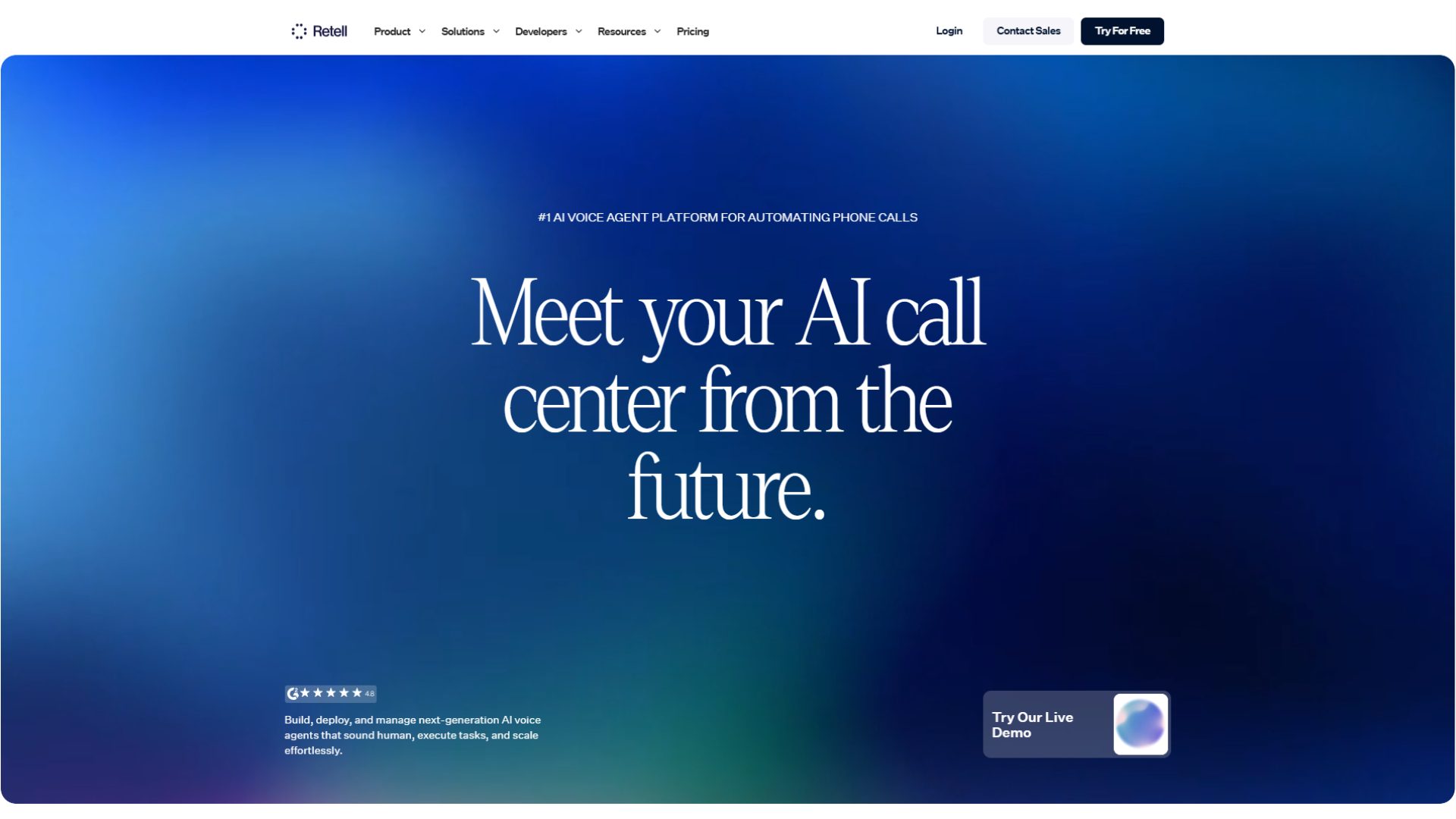
1. Retell AI: Best for Fast Launches with Built-In Testing and QA
What it does: Retell AI lets teams build, test, and run inbound and outbound phone agents from a visual conversation flow builder or through its API.
Best for: Product and CX teams that want a production phone agent live quickly, for customer support, receptionists, lead qualification or appointment booking, with testing and call analytics built in.
Retell's edge is reliability. It passed the most scenarios on all three runs of any platform benchmarked, so an agent that works in testing is more likely to keep working once callers go off script. The trade-off is speed: callers waited longest for each reply on Retell among the five platforms OpenBenchmarks measured. Tune its endpointing before launch.
Pricing is published layer by layer. You see what the voice, model, and telephony each cost, so swapping a premium voice for a cheaper one is a setting, not a migration.
Key Features
- Conversation flows: Multi-turn call logic with custom functions that call your APIs mid-call.
- Simulation testing: Automated test conversations run against the agent before it takes live calls.
- Bring your own carrier: Custom SIP trunking with no Retell telephony charge.
- Optional add-ons: Knowledge bases, noise removal, PII removal, and AI call QA, each priced per minute.
Pros and Cons
Pros:
- Highest repeat-run reliability among the platforms benchmarked
- Every layer has a published price, and calls are billed to the second
- 20 concurrent calls included before you pay for more
Cons:
- Silence and hold time are billed because speech recognition keeps listening for the whole call
- The slowest median caller wait in OpenBenchmarks' test
- Production extras add up: AI QA costs $0.10/min after the first 100 free minutes, and PII removal $0.01/min
Pricing
Retell charges 0.07–0.31 per minute on pay-as-you-go, depending on model and voice. Its own calculator example comes to $0.11/min: $0.055 for voice infrastructure, $0.015 for a platform voice, and $0.04 for the LLM. Extra concurrent calls cost $8 each per month, and Enterprise pricing is custom.
Bottom Line
Retell is the strongest starting point for a managed phone agent that has to work reliably from day one. If you need to run the stack inside your own infrastructure, LiveKit Agents or Pipecat will serve you better.
Why users choose Retell AI?
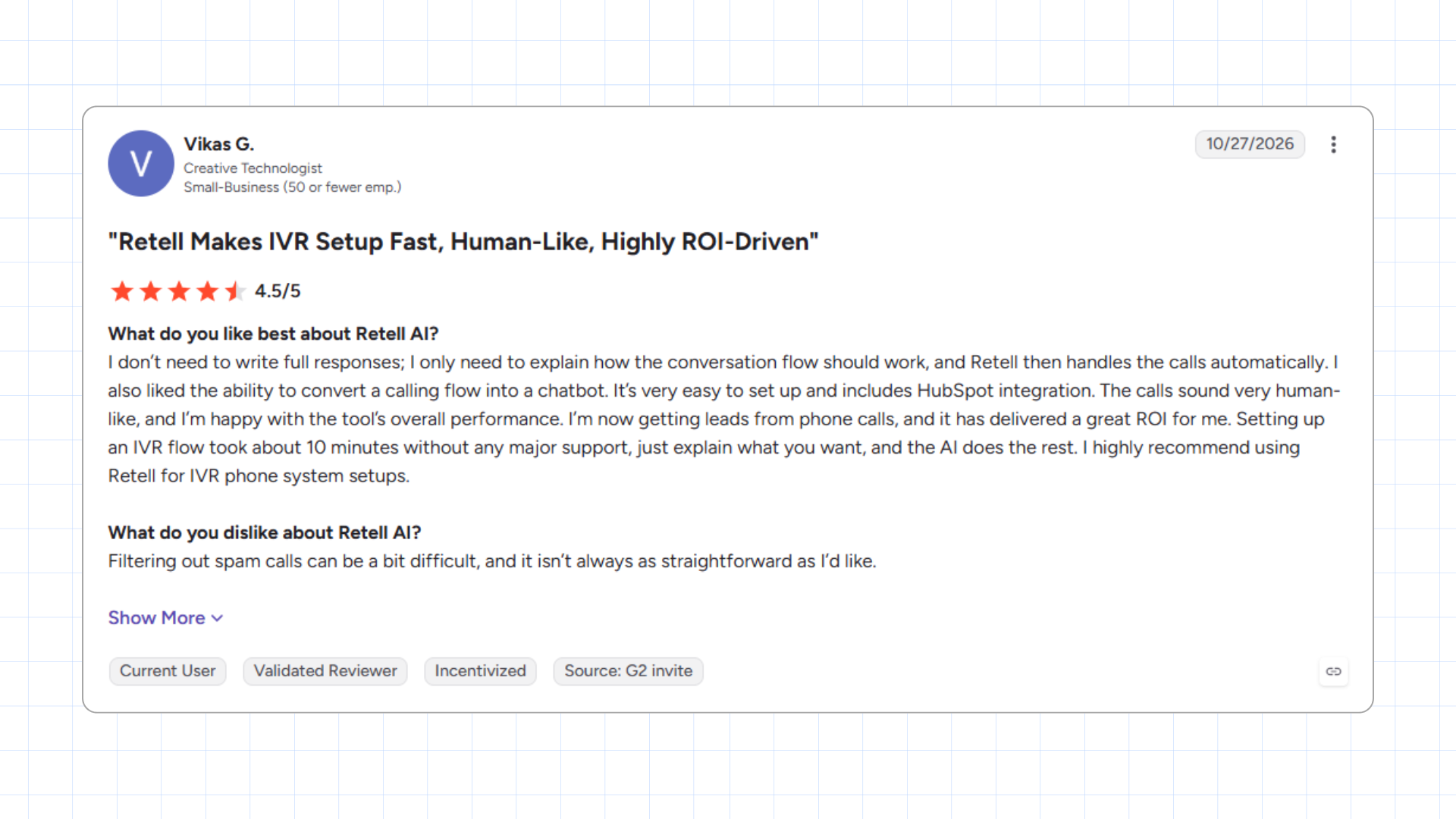
“I don’t need to write full responses; I only need to explain how the conversation flow should work, and Retell then handles the calls automatically. - G2
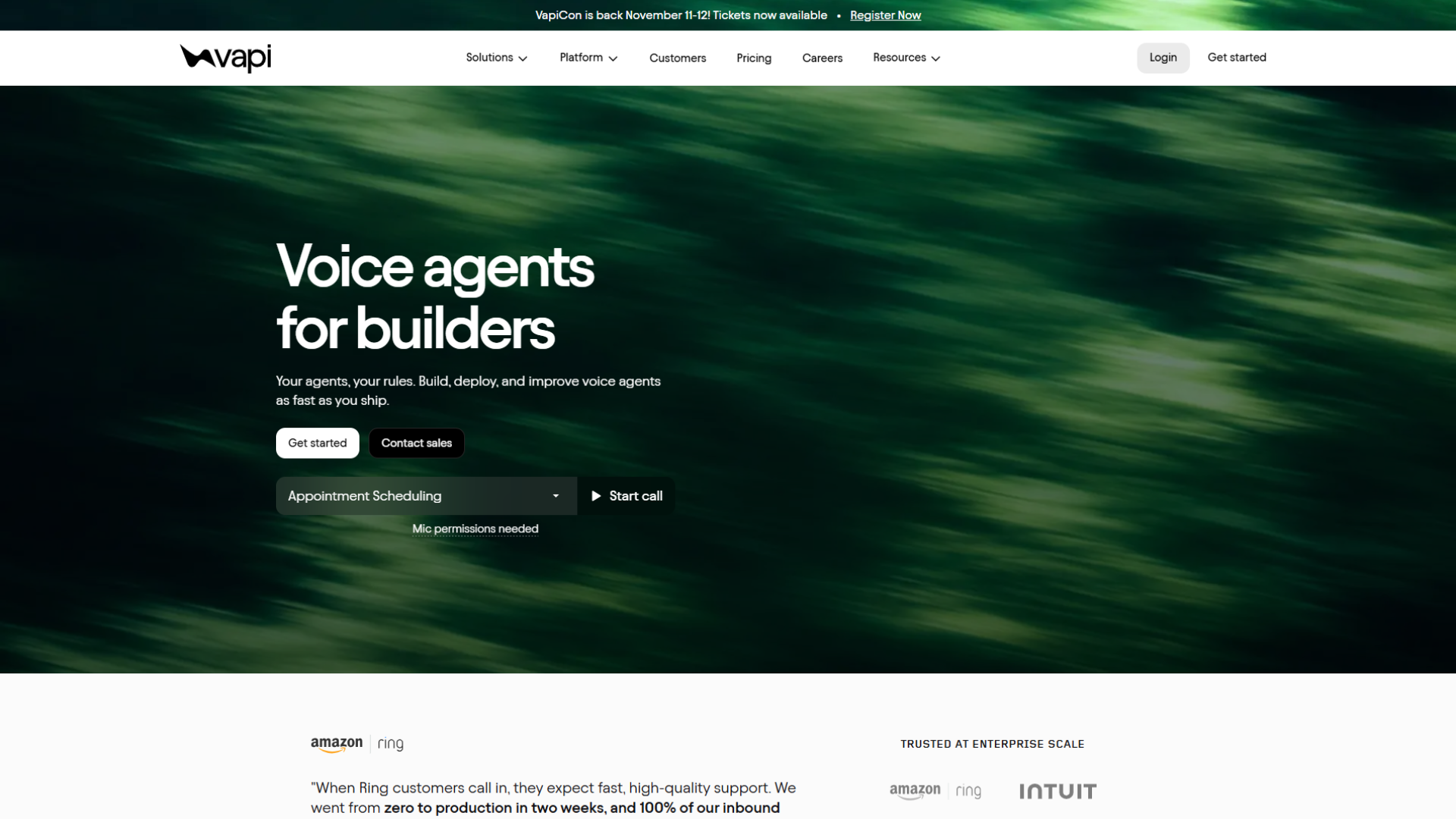
2. Vapi: Best for Developers Who Want Full Pipeline Control
What it does: Vapi hosts the real-time call orchestration, while your team chooses the transcriber, LLM, voice, and carrier.
Best for: Engineering teams building voice into their own product who want to swap model providers without rebuilding call handling.
Vapi charges only for hosting. Speech, model, and voice costs pass through at provider cost, or at $0 if you bring your own API keys. That makes it the cleanest way to compare providers on equal terms.
The flip side is ownership. Reliability on Vapi reflects the stack you assemble: it had the lowest repeat-run score of the platforms benchmarked, and each provider you add is one more service to monitor when latency or accuracy drifts.
Key Features
- Model-agnostic: Choose any supported STT, LLM, and TTS per agent, with no markup on provider costs.
- Free transport options: Vapi telephony and SIP, WebSockets, and Daily WebRTC carry no transport fee. Twilio, Vonage and Telnyx bill at their own rates.
- Testing and monitoring: Call simulation and monitoring are included with every plan.
- Success packages: Buy support, concurrency, data retention, and uptime SLAs as you scale.
Pros and Cons
Pros:
- Provider freedom: swap models as prices and quality change
- No markup on model costs, and $0 if you bring your own keys
- Testing and simulation included
Cons:
- The lowest repeat-run reliability in Cekura's benchmark, at 59.8%
- Only 4 concurrent calls without a paid success package
- HIPAA is a $2,000 monthly add-on, which dominates the bill at low volume
Pricing
Hosting costs $0.05 per minute. Core costs $29 a month for 10 concurrent calls and zero data retention. Pro costs 10% of your hosting fee, with a $999 monthly minimum, and adds a 99% uptime SLA. Premier is custom and carries a 99.9% SLA. Vapi's calculator puts 1,000 minutes with Deepgram, an OpenAI model, and an ElevenLabs voice at 82–129 a month.
Bottom Line
Vapi suits engineering teams that want full model control and are comfortable owning the stack they assemble. If you want one vendor accountable for the whole call, Retell AI or Bland AI bundle more.
Why users choose Vapi?
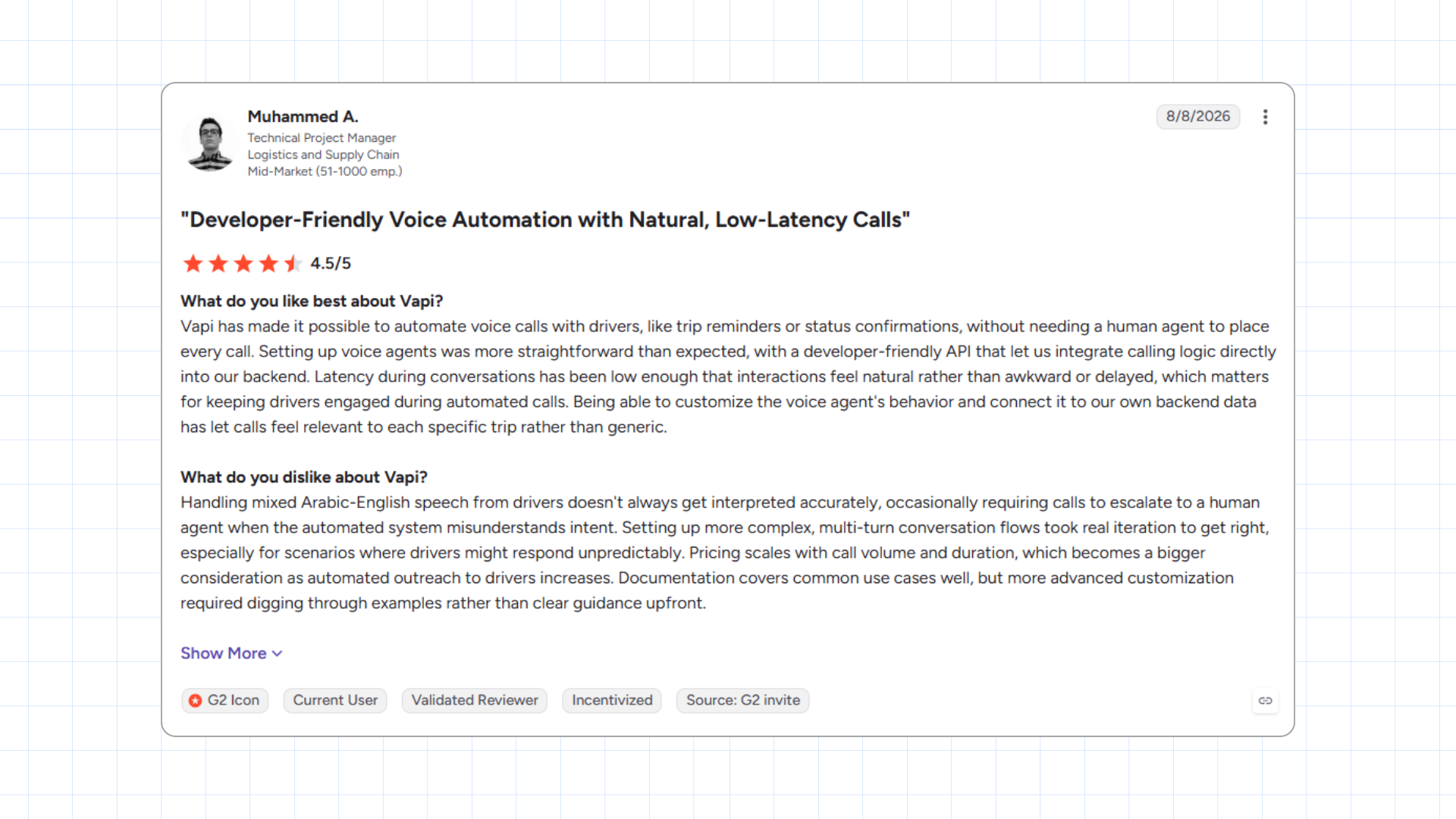
“Vapi has made it possible to automate voice calls with drivers, like trip reminders or status confirmations, without needing a human agent to place every call.” - G2
3. LiveKit Agents: Best Open-Source Platform for WebRTC and Telephony Voice Agents
What it does: LiveKit Agents is an open-source framework that provides real-time infrastructure, WebRTC, and SIP bridging to build and scale voice and video agents across web apps and phone lines.
Best for: Developers and platform teams building low-latency, real-time voice agents that need to operate seamlessly across both web applications and telephony.
LiveKit routes real-time audio and video streams through a global edge network, giving engineers precise control over transport layers, turn detection, and multi-participant media rooms.
Because it handles the complex networking layer natively, teams can focus entirely on agent logic, prompt orchestration, and connecting specialized speech models without fighting WebRTC connection drops.
Key Features
- Open-source core: Full architectural transparency and portability, runnable on cloud providers or self-hosted Kubernetes clusters.
- WebRTC and SIP integration: Direct native audio streaming for browser/app clients alongside traditional telephony trunking.
- Multi-model flexibility: Modular pipeline architecture supporting any STT, LLM, and TTS provider combination.
Pros and Cons
Pros:
- Exceptional real-time performance with ultra-low latency via WebRTC.
- Complete architectural ownership and zero vendor lock-in.
- Scales efficiently from single-agent prototypes to massive multi-user production systems.
Cons:
- Steep learning curve requiring deep familiarity with real-time networking and infrastructure management.
- More engineering boilerplate required compared to plug-and-play managed portals.
- Managing signaling servers and TURN infrastructure falls on your engineering team.
Pricing
LiveKit offers a free tier with basic agent deployment and observability tools. Paid cloud tiers start at $50/month ("Ship") and 500/month("Scale"),alongsidemeteredinfrastructureratesfortelephony(0.01/min) and managed inference components.
Bottom Line
LiveKit Agents is the best choice when absolute control over real-time audio performance and multi-channel deployment (web + phone) is non-negotiable. Pick a managed alternative like Synthflow if your team lacks backend infrastructure resources.
Why users choose LiveKit?
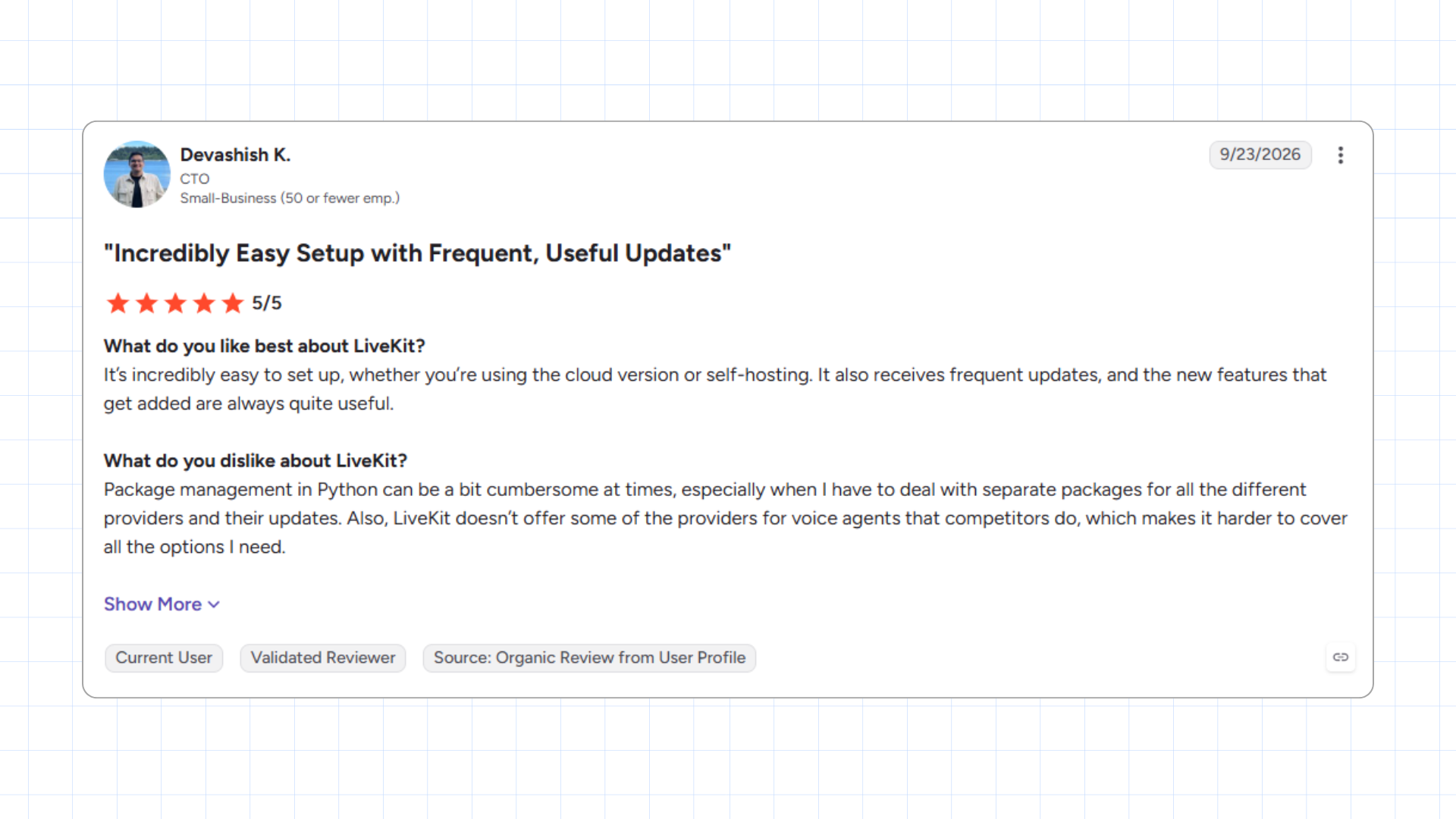
“It’s incredibly easy to set up, whether you’re using the cloud version or self-hosting. It also receives frequent updates, and the new features that get added are always quite useful.” -G2
4. Pipecat: Best Open-Source Python Framework for Custom Voice Pipelines
What it does: Pipecat is an open-source Python framework that orchestrates audio, video, models, and tools through reusable processors to build custom conversational voice pipelines.Best for: Python developers who want total control over conversation flow, custom tool calls, turn-taking logic, and provider mixing.
Pipecat acts as an orchestration layer rather than a hosted call center SaaS product. It manages the complex streaming loop between speech-to-text, LLMs, text-to-speech, and external APIs.
Features like Pipecat Flows allow developers to script structured conversational paths and state machines, ensuring the agent handles interruptions, silent gaps, and tool execution reliably.
Key Features
- Modular Python processors: Easily swap out or chain transcription, language models, and voice synthesis components.
- Advanced turn-taking and VAD: Fine-grained control over voice activity detection and interruption handling to stop bot speech naturally.
- Pipecat Flows: Built-in state machine abstraction for structured dialogues like appointment booking or data verification.
Pros and Cons
Pros:
- Ultimate flexibility to combine any voice, model, or transport provider.
- Open-source under the permissive BSD-2 license with no software license fees.
- Granular control over conversation timing, barge-in behavior, and error handling.
Cons:
- Requires writing and maintaining custom code for infrastructure, scaling, and monitoring.
- Lacks a ready-made graphical user interface or visual drag-and-drop builder for non-engineers.
- Debugging real-time audio pipeline race conditions demands strong debugging expertise.
Pricing
Completely free and open-source (BSD-2 license). Your total costs consist entirely of the underlying API providers (LLM, STT, TTS) and hosting infrastructure you choose to plug in.
Bottom Line
Pipecat is the gold standard for Python engineers building highly tailored, complex voice assistants. Pick a managed product if you need a quick, no-code visual canvas.
Why users choose Pipecat?
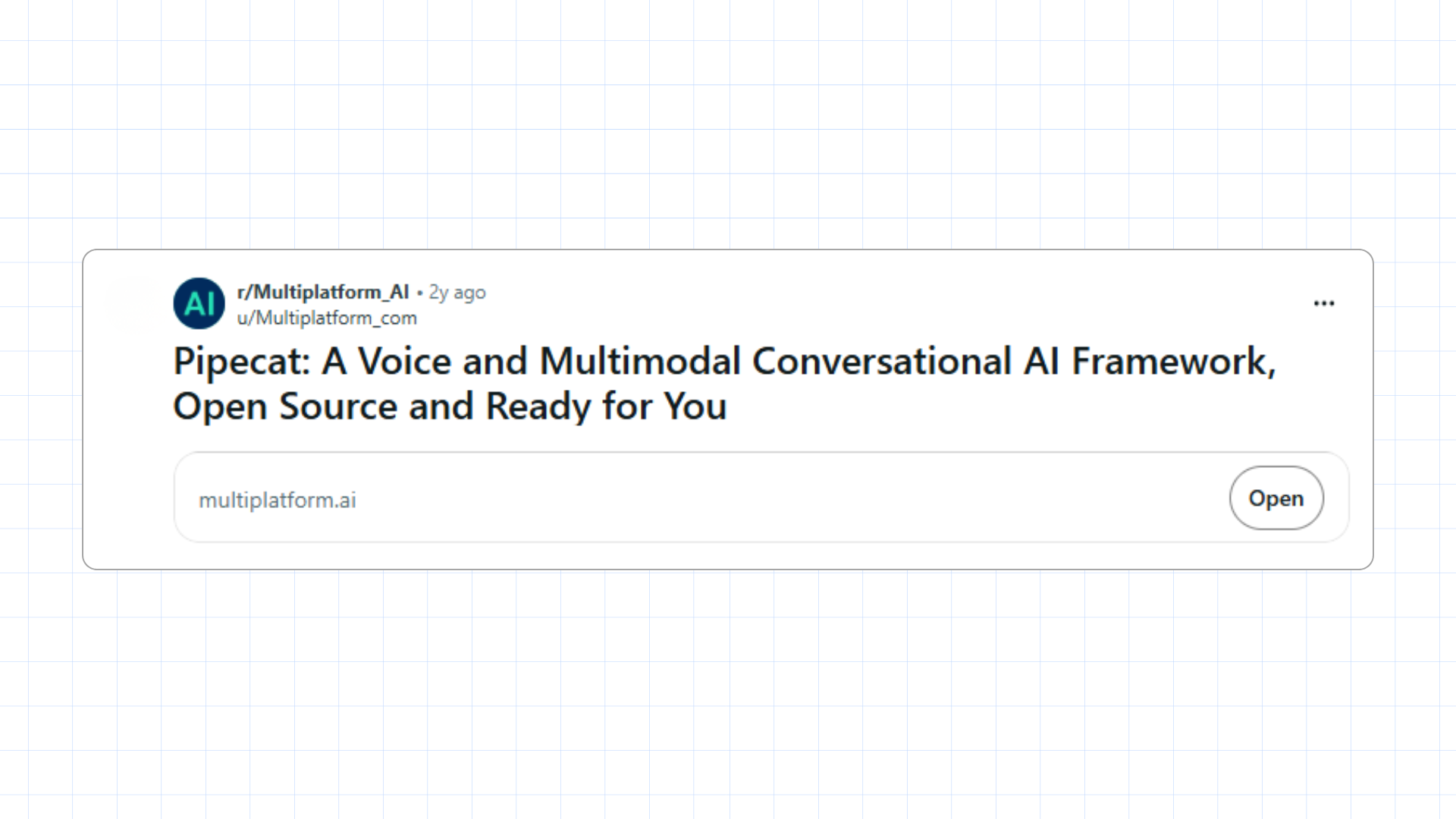
“A Voice and Multimodal Conversational AI Framework, Open Source and Ready for You” - Reddit
5. ElevenLabs Agents: Best for Human-Sounding Voices and Brand Voice Cloning
What it does: ElevenAgents is ElevenLabs' platform for building conversational agents on its own speech recognition and synthesis, over phone and web.
Best for: Consumer-facing agents where how the voice sounds affects trust and conversion, such as concierge, sales, and branded support lines.
ElevenLabs had the steadiest wait times in OpenBenchmarks' caller-side test. Its median pause was second-fastest, but its slow turns were the fastest of any platform measured, and slow turns are where callers start talking over the agent.
Part of that comes from turn-taking. Instead of waiting a fixed time after the caller goes quiet, ElevenLabs uses a learned turn model to decide when the caller has finished.
Key Features
- ElevenLabs voices: The same voices teams use for narration and dubbing, now on live calls.
- Learned turn-taking: Fewer long pauses and fewer mid-sentence interruptions.
- Workflows and tools: Add knowledge sources and webhook tools around the speech stack.
- Phone and web: One agent across telephony and in-app voice.
Pros and Cons
Pros:
- The fastest slow-turn wait in caller-side testing, at 1,768 ms
- 69.5% on repeat runs, third among platforms benchmarked
- A free plan to try it: 15 call minutes and 4 concurrent calls
Cons:
- LLM usage is passed through separately, and telephony is billed on top
- When the model is slow, the agent can fill the pause with a stall phrase like "Hmm... yeah." That can hide a slow model in your own latency numbers
- Speech choices are tied to the ElevenLabs stack
Pricing
ElevenAgents costs $0.08 per call minute, with its own speech recognition and synthesis included. LLM and telephony are extra.
Bottom Line
Choose ElevenLabs Agents when voice realism is central to the product. If you want the carrier and the agent under one vendor, Telnyx covers both.
Why users choose ElevenLabs?
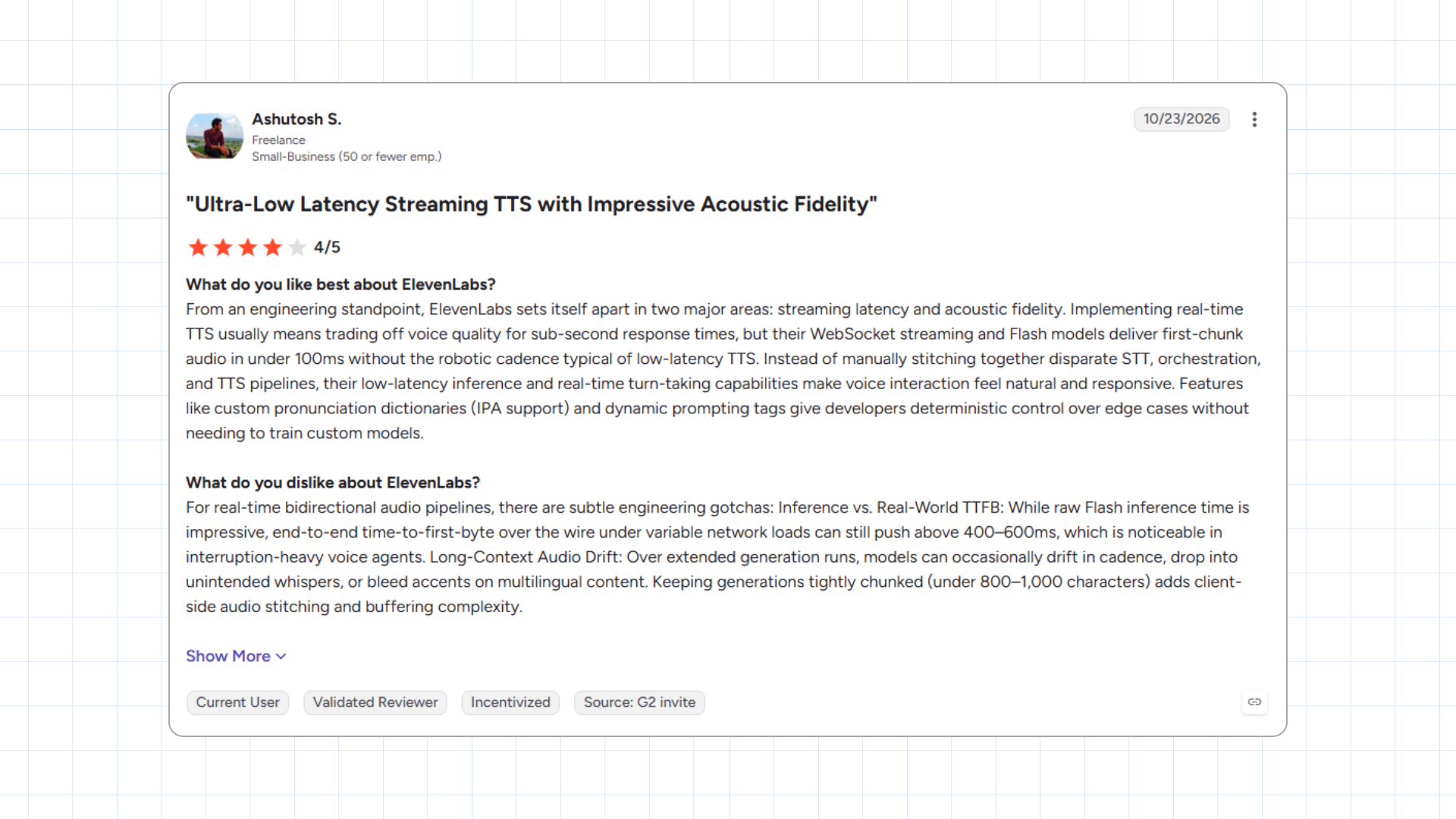
“From an engineering standpoint, ElevenLabs sets itself apart in two major areas: streaming latency and acoustic fidelity. “ - G2
6. Bland AI: Best for High-Volume Inbound and Outbound Calling
What it does: Bland AI is a phone-agent platform built for large outbound and inbound campaigns, with one per-minute rate and no separate LLM, STT or TTS charges.
Best for: Teams running reminders, follow-ups, and lead qualification at volume who want one number to budget.
Bland runs its own LLM, STT, and TTS on dedicated infrastructure, so call audio doesn't route through third-party model providers. That simplifies budgeting and data governance at the same time.
The weak spot is the tail. Bland's median caller wait was competitive in OpenBenchmarks' test, but its slow turns ran past two seconds, with the widest spread between typical and slow turns of any platform measured. On outbound calls, that's where conversations derail.
Key Features
- Conversational Pathways: Mix scripted steps with generative replies in multi-turn flows.
- Batch calling: Launch large outbound runs from a single API call.
- Bundled model stack: LLM, speech recognition and synthesis in one rate.
- Warm transfers: Hand calls to human agents, with transfer minutes billed per plan.
Pros and Cons
Pros:
- One per-minute rate covers the model and speech pipeline
- Call data stays in one stack
- Competitive median caller wait
Cons:
- Slow turns reached 2,248 ms, past the point where callers start talking again
- Daily call caps of 100, 2,000 and 5,000 on Start, Build and Scale
- Transfer minutes are billed separately, at $0.03 to $0.05
Pricing
Bland's billing docs list Start (free, 0.14/min),Build(299 a month plus 0.12/min)andScale(499 a month plus $0.11/min). Build's two-cent discount pays for its fee only above about 14,950 minutes a month.
Bottom Line
Bland fits high-volume outbound teams that want one bundled rate and one stack. If you need to choose your own models, Vapi gives you that control.
Why users choose Bland AI ?
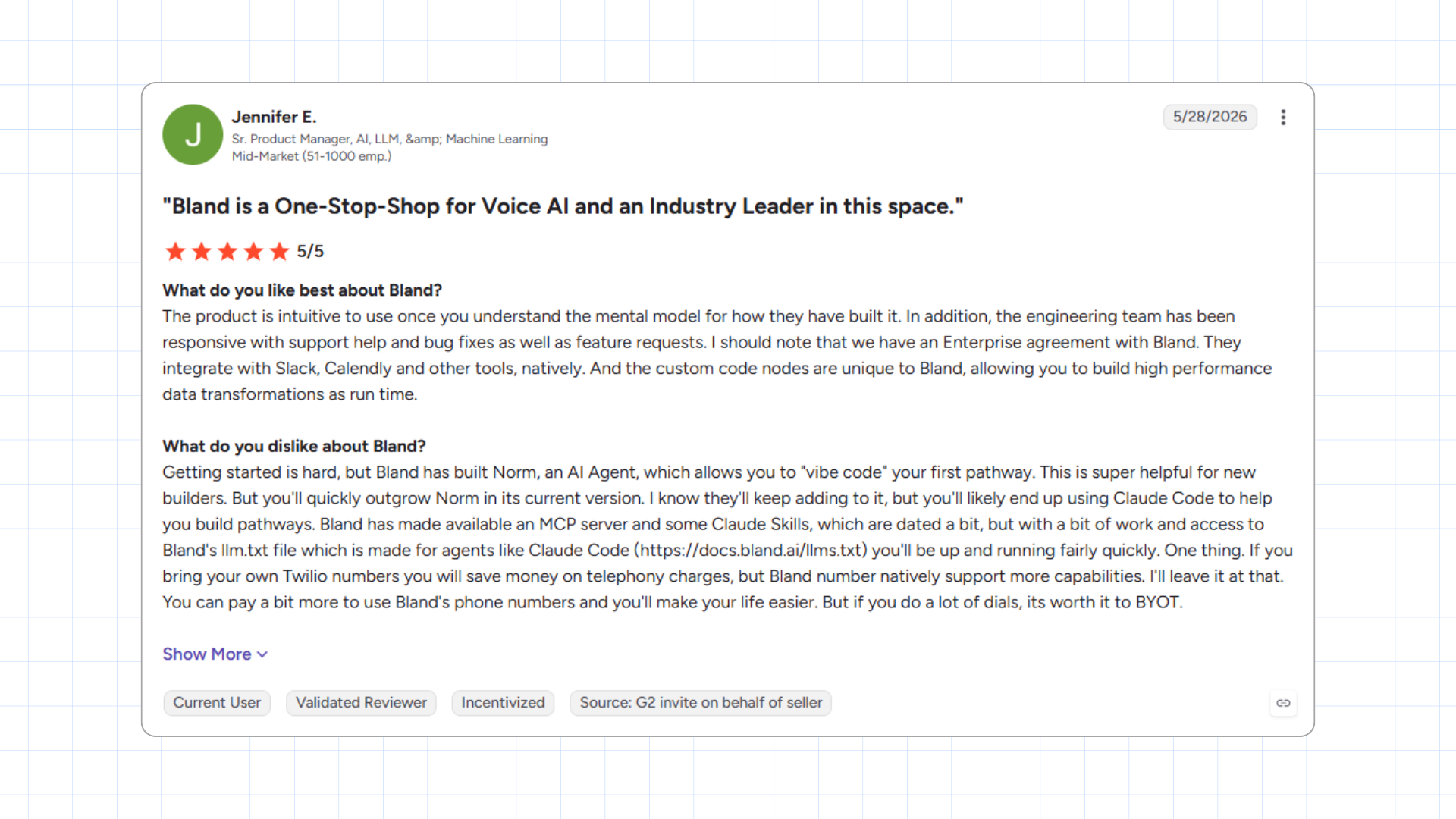
“The product is intuitive to use once you understand the mental model for how they have built in addition, the engineering team being responsive with support, help, and bug fixes, as well as feature requests. ” - G2
7. Deepgram Voice Agent API: Best for Sub-Second Speech-to-Speech Streaming
What it does: Deepgram's Voice Agent API unifies the entire voice loop (STT, LLM, and TTS) over a single WebSocket connection, minimizing round-trip latency.Best for: Developers looking to bypass multi-vendor integration overhead and build real-time voice experiences directly into custom apps.
By processing speech data inside a tightly coupled loop, Deepgram eliminates the latency penalties normally caused by passing data back and forth between separate transcription, reasoning, and synthesis APIs.
Developers connect to a single endpoint, pass their preferred model parameters, and stream bidirectional audio effortlessly.
Key Features
- Single WebSocket architecture: Cuts out intermediary network hops between disparate vendor microservices.
- Bring Your Own LLM/TTS: Flexibility to plug in custom language models or voice synthesizers while leveraging Deepgram's orchestration core.
- Enterprise security readiness: HIPAA compliance options, robust data privacy controls, and regional data residency features.
Pros and Cons
Pros:
- Industry-leading low latency due to streamlined pipeline execution.
- Simplifies architecture by replacing multiple API integrations with one unified stream.
- High reliability backed by enterprise-grade infrastructure.
Cons:
- Requires code-level implementation and WebSocket stream handling.
- Less suited for non-technical users who require visual workflow configuration tools.
- Pricing can scale quickly depending on active connection duration and chosen sub-models.
Pricing
Standard Voice Agent API pricing begins around $0.075 per minute for pay-as-you-go usage, with customized tier rates for Bring-Your-Own-LLM/TTS configurations and volume growth plans.
Bottom Line
Deepgram is ideal when raw speed and minimal latency are the absolute top priorities for an embedded app voice feature. Choose a broader platform if you need extensive out-of-the-box CRM integrations and visual flowbuilders.
Why users choose Deepgram?
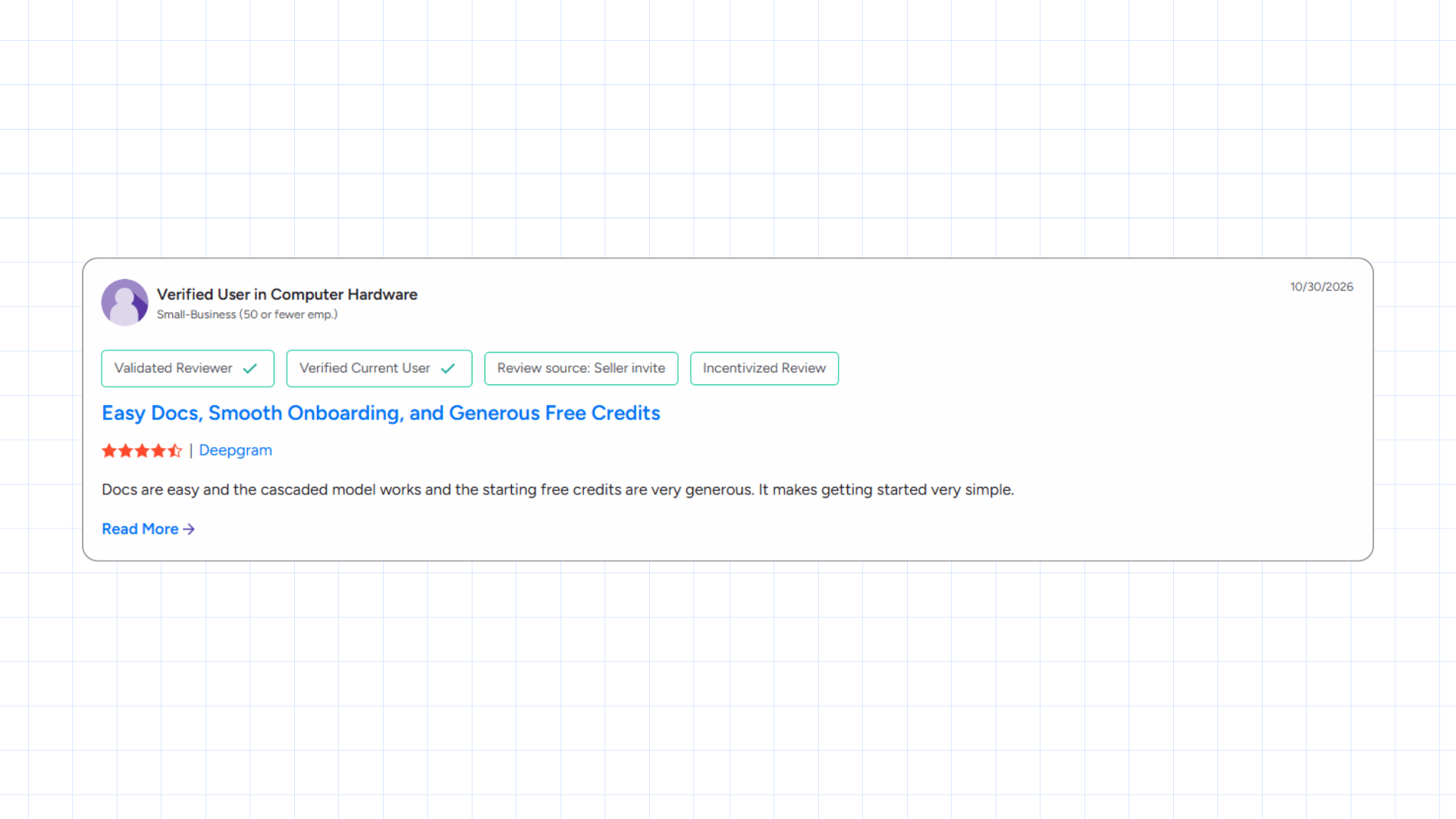
“Docs are easy, and the cascaded model works, and the starting free credits are very generous. It makes getting started very simple.” - G2
8. Telnyx Voice AI: Best for Running the Agent and Carrier on One Network
What it does: Telnyx runs voice agents on the same network and GPU infrastructure that carries the calls, allowing you to build in the portal without code or via their Assistants API.
Best for: Teams wanting to run both the agent and the carrier on one unified platform.
By keeping the agent and carrier on the same network, Telnyx minimizes network hops and places more of the call path in a single environment. Reviewers specifically call out the high quality of this underlying network.
It also deeply integrates native telephony features, meaning you do not need a separate vendor to handle numbers, SIP trunking, call recording, or warm transfers.
Key Features
- Fewer hand-offs: More of the call path stays within one environment, optimizing the route.
- Native telephony: Built-in support for numbers, SIP trunking, recording, and warm transfers.
- Transparent pricing: Combines a low voice engine rate with per-token LLM billing.
Pros and Cons
Pros:
- Keeps more of the call path in one environment, resulting in fewer hand-offs.
- Transparent pricing with a low base rate for the voice engine.
- Includes native telephony features like SIP trunking and warm transfers out of the box.
Cons:
- It is a newer entrant with fewer case studies compared to Retell or Vapi.
- Building custom tools requires real implementation work rather than plug-and-play ease.
- Has a smaller public review footprint since the voice agent product is newer.
Pricing
The core voice engine, which covers orchestration, STT, and TTS, costs $0.05 per minute. LLM and telephony are billed separately. Telnyx estimates that a production agent costs about $0.06 per minute before adding telephony.
Bottom Line
Telnyx Voice AI is the best choice when you want the carrier and the agent bundled together on the same network. Pick something else like Synthflow if you strictly want an easy drag-and-drop builder.
Why users choose Telenyx?
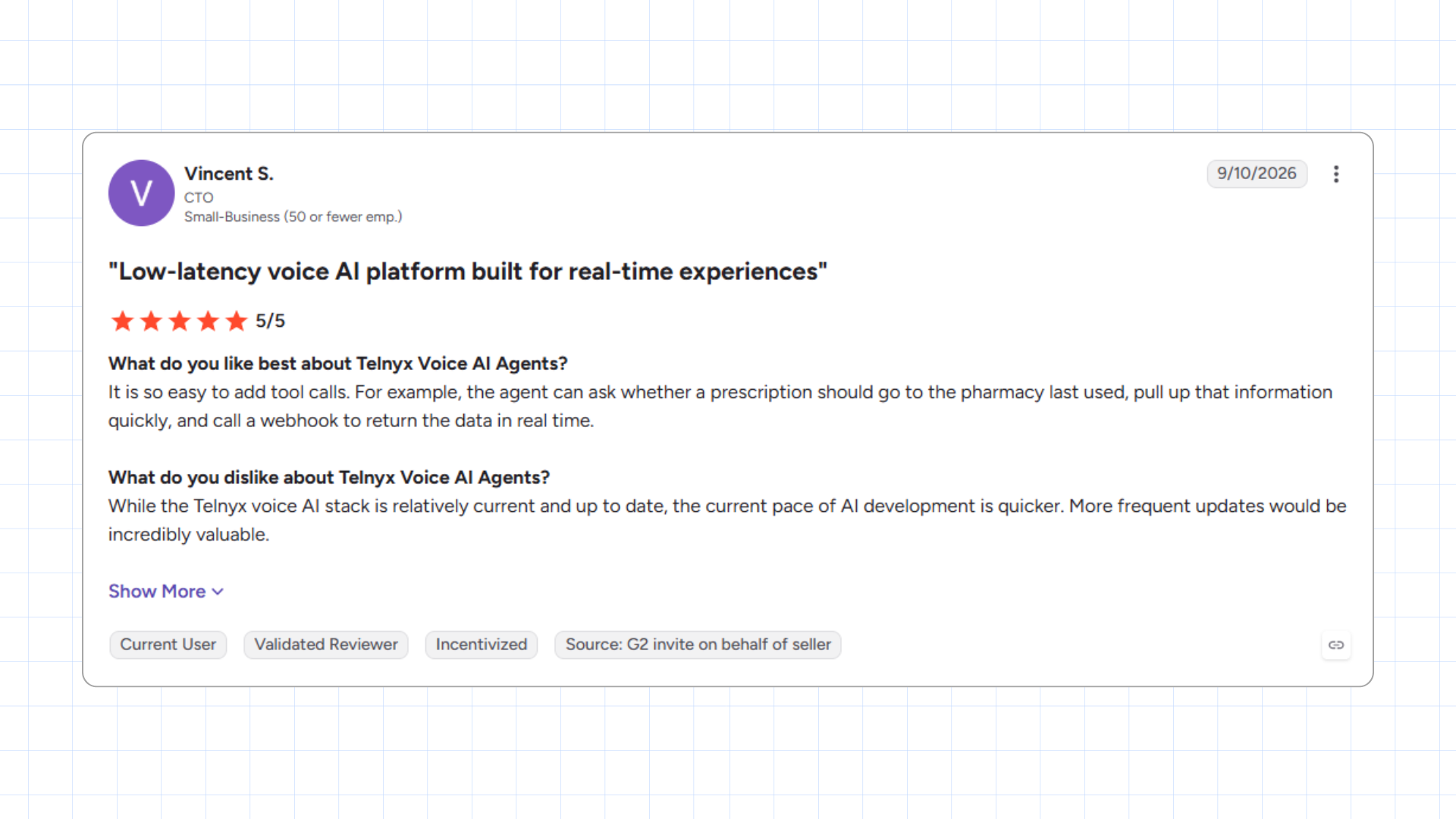
“It is so easy to add tool calls. For example, the agent can ask whether a prescription should go to the pharmacy last used, pull up that information quickly, and call a webhook to return the data in real time.” - G2
9. PolyAI: Best for Enterprise Contact Centers with Managed Delivery
What it does: PolyAI builds and operates voice agents for phone-based customer service using its own proprietary dialog model, Raven.
Best for: Large enterprise contact centers that require a managed, services-led engagement rather than self-serve software.
Unlike most API-first or no-code platforms, PolyAI is delivered entirely as a managed service. This drastically lowers the engineering load for your internal team, as PolyAI includes 24/7 support and handles the heavy lifting of building and maintaining the agent.
The platform relies on its own dialog model, Raven, to handle conversations, which reviewers praise for its natural, non-robotic voice quality. It is built for scale, boasting a strong enterprise track record that includes a reported 14-point NPS gain at UniCredit.
Key Features
- Managed delivery: A services-led engagement where the vendor builds and operates the agent.
- Proprietary dialog model: Powered by Raven, a custom model tuned specifically for natural customer service delivery.
- Enterprise governance: Comes standard with SOC 2, HIPAA compliance, and 24/7 support.
Pros and Cons
Pros:
- Natural voice quality that reviewers praise for sounding non-robotic.
- Lowers internal engineering load with included 24/7 support and managed operations.
- Proven enterprise track record with built-in SOC 2 and HIPAA compliance.
Cons:
- No trial or self-serve sign-up is available.
- Changes to custom voices and dashboards must route through PolyAI staff, which slows down updates.
- No public rate card; you have to go through a custom sales process.
Pricing
There is no public pricing available. PolyAI operates on custom per-minute enterprise contracts, so expect to go through a traditional sales process.
Bottom Line:
PolyAI is the best choice when you run a regulated, high-stakes contact center and need a fully managed service. Pick something else like Retell, Telnyx, or Synthflow when you need transparent pricing or want to run a quick pilot yourself.
Why users choose Poly AI?
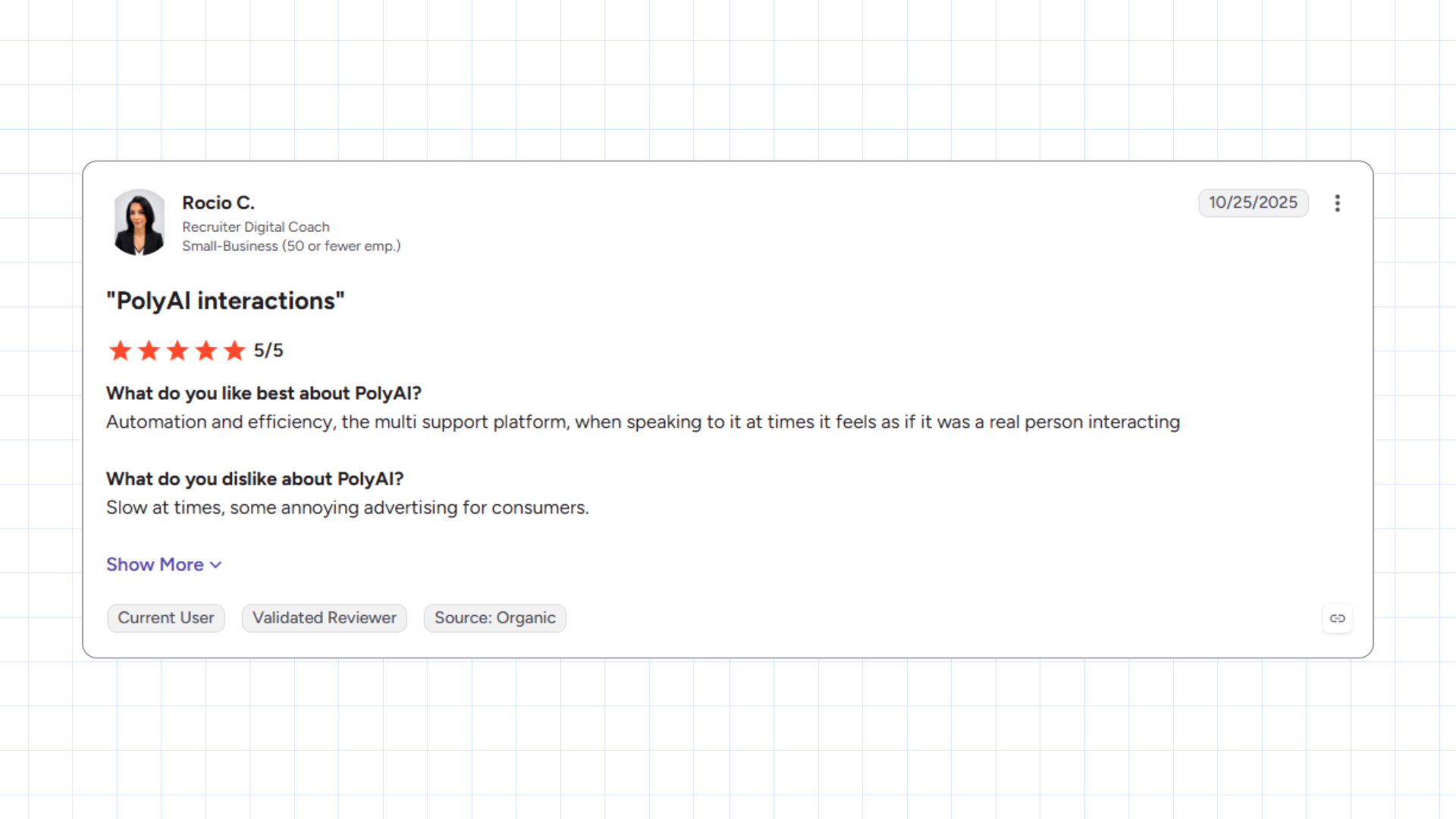
“Automation and efficiency, the multi-support platform; when speaking to it at times it feels as if it was a real person interacting “ - G2
10. Bolna: Best Voice AI Platform for Indian Languages and Regional Markets
What it does: Bolna is a conversational voice-agent platform tailored heavily toward multilingual deployments, offering out-of-the-box support for over 10 vernacular Indian languages and Hinglish.Best for: Businesses and developers targeting Indian and emerging markets where callers frequently mix languages or speak regional dialects.
Bolna bridges the gap between low-code ease of use and developer extensibility. It allows teams to deploy outbound campaigns, setup automated phone workflows, and integrate smoothly with tools like n8n, Zapier, and Make.com.
Its core strength lies in optimizing transcription and synthesis accuracy across diverse regional accents.
Key Features
- Deep vernacular support: Native handling of 10+ Indian languages and natural code-switching (like Hinglish).
- Workflow integrations: Clean webhook connections and native hooks for automation platforms like Zapier and Make.
- Campaign and telephony management: Built-in tools for tracking call analytics, managing phone numbers, and handling batch calling.
Pros and Cons
Pros:
- Unmatched capability for handling regional Indian accents and mixed-language conversations.
- Offers both user-friendly setup flows and API flexibility.
- Cost-effective starting rates for high-volume calling.
Cons:
- Platform flexibility can feel constrained compared to entirely custom Python frameworks like Pipecat.
- Advanced enterprise features and high concurrency limits require custom plan tiers.
- Documentation and community resources are more niche compared to massive global competitors.
Pricing
Pay-as-you-go tiers start around $0.02 to $0.06 per minute plus underlying model costs, with structured bundle plans (such as Starter and Pilot tiers ranging from $100 to $1,000) tailored for growing business volume.
Bottom Line
Bolna is the top pick for projects operating in India that require stellar regional language and Hinglish processing. Choose a platform like Vapi if your user base is entirely English-centric and globally distributed.
"Bolna's recruitment platform is a game changer! Six months ago, hiring a backend developer took us an entire month. Last month, we needed a frontend developer, and the process was wrapped up in just three days. The difference? Bolna's AI-driven pre-screening made it super efficient. - Product Hunt"
The 4 Layers of a Voice AI Stack
"Platform" is a loaded word in this market. Some vendors sell a finished no-code product, some sell an API for developers, and others supply only audio components. Separate the stack into four layers before you compare tools.
Most platforms in this guide sit in the orchestration layer as hosted builders: you configure an agent instead of managing model weights. Open-source frameworks such as Pipecat and LiveKit Agents offer a self-hosted path, covered later.
Which AI Voice Agent Platform Should You Choose?
Headline rates for voice AI can be deeply misleading. While marketing highlights starting prices as low as $0.02 to $0.14 per minute, real production costs typically land between $0.05 and $0.15 per minute once you factor in orchestration, transcription, LLM tokens, voice synthesis, and telephony routing.
No single platform is "best"; the right choice depends on your use case and technical stack. For fast launches, Retell AI is best. For full pipeline control, choose Vapi; for open-source Python pipelines, Pipecat or LiveKit Agents; for voice-realism-first products, ElevenLabs Agents; for high-volume outbound calls, Bland AI; for a native carrier network, Telnyx Voice AI; and for enterprise contact centers, PolyAI. Ultimately, start with what your team can own; engineering capacity and data rules narrow the field faster than any comparison chart.
- Choose Retell AI if you:
- Need a managed phone agent in production within weeks, with published per-layer pricing.
- Want simulation testing and post-call analytics without building your own.
- Choose Vapi if you:
- Are building a voice into your own product and want to pick every model yourself.
- Plan to bring your own provider keys to keep model costs at source rates.
- Choose LiveKit Agents or Pipecat if you:
- If you want open-source flexibility to build custom WebRTC, SIP, or Python-based audio pipelines.
- Need absolute architectural control and portability across your own cloud or Kubernetes clusters.
- Choose ElevenLabs Agents if you:
- Sell an experience where voice realism and emotional range drive trust or conversion.
- Care most about avoiding robotic delivery and long pauses on slow turns.
- Choose Bland AI if you:
- Run high-volume outbound campaigns and want one bundled rate for model and speech.
- Prefer call data to stay inside a single vendor's stack.
- Choose Deepgram Voice Agent API if you:
- Want a single WebSocket, sub-second speech-to-speech loop embedded directly inside your own application.
- Want a single WebSocket, sub-second speech-to-speech loop embedded directly inside your own application.
- Choose Telnyx Voice AI if you:
- Want the carrier and the agent on one native network and one bill.
- Need to minimize network hops to get the shortest typical pause on phone calls.
- Choose Livekit Agents if you:
- Want open-source flexibility to build custom WebRTC or SIP audio pipelines.
- Need absolute architectural control and portability across your own cloud or Kubernetes clusters.
- Choose PolyAI if you:
- Run a large, regulated contact center and want a fully managed service partner.
- Have the procurement time for a traditional sales-led evaluation.
- Choose Bolna if you:
- Are targeting Indian or regional markets requiring native handling of over 10 vernacular languages and Hinglish.
- Are targeting Indian or regional markets requiring native handling of over 10 vernacular languages and Hinglish.
- Own the model layer yourself if you:
- Must keep call audio and transcripts in your own cloud or region for DPDP, GDPR, or HIPAA compliance.
- Run enough steady volume that renting a dedicated GPU beats per-minute SaaS pricing.
- Already use open-source frameworks and want absolute control over model latency.
What Does an AI Voice Agent Platform Really Cost per Minute?
Headline starting rates run from $0.02/min to $0.14/min, but each platform covers a different slice of the stack:
Compliance can completely reshape these totals at lower volumes. For instance, a $2,000 monthly HIPAA compliance add-on will easily cost more than the usage itself for a growing team running just a few thousand minutes a month.
When Does Serving Your Own Models Pay Off?
Hosting your own speech and model layers on dedicated GPUs replaces the $0.033 to $0.079 per-minute SaaS cost of transcription, LLMs, and synthesis. Assuming 24/7 cloud operation (730 hours/month), the break-even thresholds are:
- NVIDIA T4 ($876/month at $1.20/hour): Breaks even at 11,100 to 26,500 minutes monthly.
- NVIDIA H200 ($3,796/month at $5.20/hour): Breaks even at 48,000 to 115,000 minutes monthly.
While you still pay for orchestration, telephony, and engineering maintenance, you can maximize ROI by using scale-to-zero architectures to cut idle costs, applying quantization to fit heavier models on cheaper hardware, and utilizing reserved compute capacity.
The Bottom Line: Choosing Your AI Voice Agent Platform
Choosing the right AI voice agent platform ultimately comes down to how much of the stack your engineering team wants to own and the actual call volume you plan to process. A flawless demo does not guarantee production reliability, which is why testing for real-world latency, interruption handling, and fully loaded per-minute costs is a mandatory step before launch. If your priority is speed to market, managed platforms like Retell or PolyAI will get your agents live the fastest. If you require absolute pipeline control or custom integrations, developer-focused tools like Vapi or open-source frameworks like Pipecat and LiveKit provide the architectural freedom you need. As your outbound or inbound minutes scale, transitioning to your own inference infrastructure with dedicated GPUs will be the smartest way to keep your unit economics viable. Always test on real phone lines, monitor your slow turns closely, and commit to the platform that aligns with your technical capacity and growth trajectory.
Frequently Asked Questions (FAQ)
What is the best AI voice agent platform?
No single platform is "best"; the right choice depends on your use case. Retell AI is best for fast launches with managed infrastructure, Vapi for full pipeline control, Pipecat and LiveKit for open-source Python frameworks, ElevenLabs for voice realism, Bland AI for high-volume outbound calls, Telnyx for native carrier integration, and PolyAI for enterprise contact centers.
Is there a free AI voice agent platform?
Yes. Open-source frameworks like Pipecat and LiveKit Agents are free to use, though you pay for underlying APIs and hosting. Commercial tools like Retell, Vapi, and ElevenLabs offer free tiers or trial credits, but production use at scale always incurs usage and telephony costs.
What is an AI voice agent?
An AI voice agent is a conversational software system powered by speech-to-text, Large Language Models, and text-to-speech. Unlike legacy rigid voicebots, they understand context, handle interruptions, execute tool calls, and converse naturally over phone lines or apps.
How much does an AI voice agent cost per minute?
Fully loaded production costs typically range between $0.05 and $0.15 per minute, while premium models or compliance add-ons can exceed $0.30/min. Total costs include orchestration, speech recognition, LLM tokens, voice synthesis, and telephony routing.
How do you build an AI voice agent?
You can build one using a managed platform (like Retell or Vapi) via a visual dashboard, or by coding a custom pipeline using open-source Python frameworks (Pipecat or LiveKit) to chain transcription, reasoning, and voice models over WebSockets or SIP trunking.
Which AI model is best for voice agents?
The best model balances low latency and reasoning. Fast, lightweight LLMs (such as optimized Llama or GPT variants) keep response times low, Deepgram Nova or Whisper handle transcription, and ElevenLabs leads in voice synthesis.
What is good latency for an AI voice agent?
A pipeline latency under 400 to 500 ms is ideal, keeping total caller-perceived response time under 1.5 seconds for a natural, fluid conversation. Pauses exceeding two seconds cause callers to talk over the agent or assume the line dropped.
How do you test an AI voice agent before going live?
Test real-world performance by running repeat-run call scenarios, checking mid-sentence interruption handling, simulating slow API failures, testing peak concurrent call loads, and measuring actual phone call latency.
Can AI voice agents speak Indian languages?
Yes. Platforms like Bolna provide out-of-the-box support for regional Indian languages and natural code-switching (like Hinglish), while developer-centric frameworks support multilingual models depending on your STT and TTS providers.